



 Tihan, Eusebiu Jean (2026), The Collapse of the Judicial System: From an Instrument of Hierarchy to a Victim of Anarchy, Cunoașterea Științifică, 5:2, 50-73, DOI: 10.58679/CS73548, https://www.cunoasterea.ro/the-collapse-of-the-judicial-system/
Abstract
This paper aims to investigate the trajectory of the functional metamorphosis of the judicial system, analyzing its transformation from an arbiter of the law in a rule-of-law state, to an instrument for consolidating an oligarchic hierarchy, and, ultimately, to a victim of anarchic disorder. The primary objective is the development of an integrative theoretical framework, based on classical sociology, to explain the dynamics of judicial collapse as a function of the erosion of social cohesion. A secondary, yet practically essential, objective is the construction and validation of a quantitative instrument – the Judicial Stability Index (JSI) – which enables the operational diagnosis and early warning of this collapse.
Keywords: judicial system, social entropy, Salami Slice Method, rule of law, Gemeinschaft, Gesellschaft, reciprocity, stability index, politicization, anarchy
Prăbușirea sistemului judiciar: de la un instrument al ierarhiei la o victimă a anarhiei
Rezumat
Această lucrare își propune să investigheze traiectoria metamorfozei funcționale a sistemului judiciar, analizându-i transformarea de la arbitru al legii într-un stat de drept, la instrument de consolidare a unei ierarhii oligarhice și, în final, la victimă a dezordinii anarhice. Obiectivul principal este dezvoltarea unui cadru teoretic integrativ, bazat pe sociologia clasică, care să explice dinamica prăbușirii judiciare ca o funcție a erodării coeziunii sociale. Un obiectiv secundar, dar practic esențial, este construirea și validarea unui instrument cantitativ – Indicele de Stabilitate Judiciară (ISJ) – care să permită diagnosticarea operațională și avertizarea timpurie asupra acestei prăbușiri.
Cuvinte cheie: sistem judiciar, entropie socială, Metoda Salamului, stat de drept, Gemeinschaft, Gesellschaft, reciprocitate, indice de stabilitate, politizare, anarhie
CUNOAȘTEREA ȘTIINȚIFICĂ, Volumul 5, Numărul 2, Iunie 2026, pp. 50-73
ISSN 2821 – 8086, ISSN – L 2821 – 8086, DOI: 10.58679/CS73548
URL: https://www.cunoasterea.ro/the-collapse-of-the-judicial-system/
© 2026 Eusebiu Jean TIHAN. Responsabilitatea conținutului, interpretărilor și opiniilor exprimate revine exclusiv autorilor.
The Collapse of the Judicial System: From an Instrument of Hierarchy to a Victim of Anarchy
Psych. Eusebiu Jean TIHAN, MSc[1]
eusebiu.tihan@gmail.com
[1] Independent researcher, https://orcid.org/0009-0008-8316-3679
Objectives: This paper aims to investigate the trajectory of the functional metamorphosis of the judicial system, analyzing its transformation from an arbiter of the law in a rule-of-law state, to an instrument for consolidating an oligarchic hierarchy, and, ultimately, to a victim of anarchic disorder. The primary objective is the development of an integrative theoretical framework, based on classical sociology, to explain the dynamics of judicial collapse as a function of the erosion of social cohesion. A secondary, yet practically essential, objective is the construction and validation of a quantitative instrument – the Judicial Stability Index (JSI) – which enables the operational diagnosis and early warning of this collapse.
Method: The study adopts a theoretical-structural analysis methodology, drawing on the fundamental sociological typologies of Ferdinand Tönnies – Gemeinschaft (community) and Gesellschaft (society) – and the concept of social entropy. Through a moderate functionalist approach, the judicial system is treated as a specialized subsystem for conflict management and the maintenance of systemic trust. The methodology combines qualitative analysis of institutional processes with the development of a composite quantitative model (JSI). This is constructed by identifying four structural pillars (Politicisation, Coercive Efficacy, Reciprocity, Predictability), operationalized into measurable indicators. The theoretical and empirical validation of the model is conducted through comparative historical (Nazi Germany, Romania 1989) and contemporary (states in authoritarian drift) case studies.
Results: The research demonstrates that the functional collapse of justice occurs when the principle of reciprocity, fundamental to the equilibrium of a Gesellschaft system, is abandoned in favor of a teleological ethics of the “End” or “Purpose”, characteristic of oligarchic Gemeinschaft, or is simply annihilated by the dissolution of state authority into anarchy. The erosion process is marked by specific and predictable phenomena: acute social polarization, the incremental application of the “Salami Slice Method” against judicial independence, and the replacement of the supremacy of law with the supremacy of a particular will. The JSI proves to be an effective instrument for mapping this trajectory and identifying critical inflection points.
Conclusions: The judicial system is not an autonomous entity or a mere set of institutions, but a profoundly sensitive barometer of the health and equilibrium of the society it serves. Its protection, and by extension that of national security, requires more than cosmetic legal reforms; it demands the active maintenance and reconstruction of those social conditions which define a functional Gesellschaft: reciprocity, systemic trust, and the absolute supremacy of the law over any immediate political purpose. When justice begins to operate according to the logic of “Cui prodest?” (who benefits?), it ceases to be part of the solution and becomes an engine of the problem, paving the way either towards efficient tyranny or towards violent chaos.
Public Significance Statement: This article provides both a clear theoretical framework and a practical diagnostic tool for policymakers, academia, and civil society. It signals that signs of judicial politicization, erosion of reciprocity, and application of the “Salami Slice Method” are not mere political irregularities, but symptoms of a dangerous structural transition of the entire society, from a rule-of-law state towards an oligarchic model or dissolution into anarchy. Recognizing these early signals is an essential condition for any policy of resilience and sustainable national security.
1. Introduction: Justice as a Mirror of Social Cohesion
The crises of judicial systems constitute one of the most salient signals of a society in structural convalescence. Often, these crises are analyzed through the lens of reductive factors: administrative inefficiency, individual corruption of some magistrates, or punctual political conflicts. However, a deeper analysis shows that justice functions not only as a public service, but as an extremely sensitive barometer of social cohesion and health (Fukuyama, 2011). It does not exist in an institutional vacuum, but is embedded in and, simultaneously, upholds one of the two fundamental ethical foundations of human organization, as theorized by the father of modern sociology, Ferdinand Tönnies (1887).
On the one hand, justice can embody the Law as an end in itself – a body of abstract, universal, autonomous, and predictable norms, which stand above the will of any individual or any group, and which constitute the backbone of what Tönnies called Gesellschaft (society). Gesellschaft is the world of voluntary association, contract, instrumental reason, and individualism, specific to modernity. Here, justice is the impersonal arbiter of these norms.
On the other hand, justice can transform into the Law as an instrument for a higher purpose – collective utility defined by a narrow group, natural hierarchical order, ideological purity, or nationally interpreted interest oligarchically. This is the logic of Gemeinschaft (community), the world of organic bonds, tradition, hierarchy accepted as natural, and collective identity predominating over the individual. In this world, justice becomes the expression and instrument of this hierarchy.
The central thesis of this article is that the functional collapse of the judicial system follows a predictable structural trajectory, analyzable through the prism of this dichotomy and the intermediate space of chaos. It starts from the slow or violent transformation of justice from an arbiter of law (Gesellschaft) into an instrument of hierarchy (oligarchic Gemeinschaft). In the terminal stage, with the collapse or withdrawal of the central authority that had instrumentalized it, justice becomes the first collateral victim of total chaos (Anarchy), a space where laws remain on paper, but brute force or private protection become the only arbiters. This transition is not a historical accident, but a systemic process, fueled by the erosion of the principle of reciprocity – the cornerstone of any functional social contract – and by the rise of a teleological ethic that justifies suspending any procedure in the name of a “Purpose” above all.
The aim of this work is dual and complementary:
- Theoretical: To provide an integrative and interdisciplinary theory of the dynamics of judicial system collapse, anchored in classical sociology (Tönnies, Durkheim, Weber), systems theory (Luhmann), and political science. This theory will clarify how macrostructural social factors (polarization, trust deficit) determine micro-institutional dysfunction.
- Applicative and Diagnostic: To construct and validate an applicable analytical instrument, the Judicial Stability Index (JSI), which allows the translation of qualitative theoretical concepts into a quantitative or semi-quantitative diagnostic model. The JSI will act as an early warning system, capable of identifying alarm signals (“red flags”) of judicial erosion already in incipient phases, allowing for corrective interventions before reaching a critical point of no return.
To achieve these aims, the paper is structured as follows. After this introduction, Section 2 will precisely establish the methodological positioning and epistemological limits of the endeavor. Section 3 will detail the theoretical model, analyzing the characteristics of justice in the ideal-typical regimes of oligarchic Gemeinschaft (3.1) and Gesellschaft (3.2). Section 4 will describe the mechanism of transition and collapse, focusing on signs of erosion: polarization and the “Salami Slice Method” (4.1). Section 5 will explore the terminal stage of functional collapse in the anarchic regime, and Section 6 will analyze the special case of accelerated collapse following a sudden transition. Section 7, the applicative core, will present in detail the necessity, construction methodology, structure, and calculation formula of the Judicial Stability Index (JSI), including its interpretation grid. Section 8 will validate the instrument through comparative historical and contemporary case studies, and Section 9 will present general conclusions and implications for institutional resilience policies.
2. Methodological Positioning and Epistemological Limits
2.1. Nature of the Scientific Endeavor: A Theoretical-Structural Analysis with Heuristic and Diagnostic Aspirations
This paper adopts a theoretical-interpretive and structural-comparative approach. It does not seek to test a narrow statistical hypothesis through multivariate analysis of a large dataset, but aims to construct a robust theoretical framework and an integrative explanatory model for understanding the complex institutional dynamics of the judicial system. The analysis is deliberately interdisciplinary, borrowing and synthesizing fundamental concepts from:
- Classical Sociology: Tönnies’s typologies (Gemeinschaft/Gesellschaft), Durkheim’s concept of mechanical/organic solidarity (1893), and Weber’s ideas (1904) about traditional, legal, and charismatic domination.
- Political Science and Rule of Law Theory: The works of Dicey (1885), Hayek (1944), and contemporary discussions on illiberalism and “state capture” (Bankuti, Halmai & Scheppele, 2012).
- Systems Theory (Luhmann, 2004): To understand the judicial system as a differentiated functional subsystem, with its binary code (legal/illegal) and its role in reducing complexity and maintaining systemic trust.
The central model is one of oscillation between ideal-typical poles. Gemeinschaft and Gesellschaft are not descriptions of real societies, but Weberian ideal types – exaggerated mental constructs that serve as reference points to understand the direction and intensity of change in real systems (Weber, 1904). No real judicial system is a pure Gesellschaft, just as none is a pure Gemeinschaft. They oscillate between these poles, and the position on this axis determines its health and functionality.
2.2. Epistemological Positioning: A Modern Functionalist Structuralism
A moderate structuralist-functionalist perspective is adopted, inspired by Luhmann (2004) and Merton (1968). The judicial system is treated as a specialized social subsystem, whose primary function (in systemic-functional terms) is the management of society’s “normative tension.” It transforms particular conflicts, divergent interests, and norm violations into universalizable, binary decisions (winner/loser, guilty/innocent), which restores a state of normative expectation. This function is essential for:
- Reducing Complexity: It provides a predictable channel for dispute resolution, instead of private revenge or perpetual struggle.
- Maintaining Systemic Trust: It assures social actors that the rules of the game are stable and apply to everyone, facilitating long-term cooperation and investments (Fukuyama, 1995).
- Stabilizing Expectations: It produces a certain predictability regarding the consequences of actions, essential for individual freedom and planning.
The functionalist approach allows us to observe how changes in the broader structure of society – such as acute political polarization, collapse of central authority, or the rise of a cohesive oligarchy – perturb and, ultimately, destroy the judicial system’s ability to fulfill this function. Dysfunction (Merton, 1968) appears when the system’s output (sentences) no longer contributes to the stability of the general system, but undermines it.
2.3. Conceptual, Operational, and Generalization Limits
It is crucial to recognize and warn about the inherent limits of this endeavor:
- Ideal-Typical Nature of the Models: Gemeinschaft and Gesellschaft are heuristic tools, not photographs of reality. Their use involves a certain simplification. Reality can also present hybrid or paradoxical forms that do not fit perfectly into the model.
- Operationalization and Measurability: The construction of the Judicial Stability Index (JSI) involves transforming profoundly qualitative and normatively-loaded concepts (“reciprocity,” “politicization,” “trust”) into measurable indicators. This inevitably introduces a validity problem – are we truly measuring the intended concept? – and an issue of data availability. The proposed indicators rely on data that may be incomplete, partial, or difficult to compare between states.
- Generalization from Case Studies: Conclusions drawn from the selected historical and contemporary case studies, although illustrative and strongly suggestive, cannot claim to be universally valid for all societies, under all historical conditions. The model has theoretical and heuristic validity, rather than a deterministic predictive one.
- Attention to Agency and Cultural Factors: The structural approach can underestimate the role of individual and collective agency (courageous judges, civic movements) in countering tendencies of decline. Also, deeply rooted cultural factors (mentalities, historical relationship with the law) can act as powerful intervening variables, moderating the effect of the identified structural mechanisms.
Despite these limits, the endeavor remains valid and necessary. It offers a conceptual map to navigate the complexity of institutional collapse and a practical instrument to identify dangerous tendencies, even if its measurements cannot claim the precision of exact sciences.
3. The Theoretical Model: From Gemeinschaft to Gesellschaft – An Axis of Judicial Functionality
Analyzing the dynamics of the judicial system requires a clear understanding of the two ideal-typical states between which it oscillates. This section details the fundamental characteristics of justice in oligarchic Gemeinschaft and Gesellschaft regimes, highlighting how each structural configuration produces a distinct legal ethic and, therefore, a different functionality.
3.1. The Gemeinschaft Regime: Justice as Expression and Instrument of Hierarchy
Within a social order of the Gemeinschaft type, as theorized by Tönnies (1887), social bonds are perceived as organic, predetermined, and founded on tradition, blood, and territory. Hierarchy is not seen as an artificial construction, but as an expression of a natural or divine order. In such a configuration, the judicial system ceases to be a neutral arbiter between equal parties. It becomes a mechanism for codifying and enforcing the existing hierarchy, an instrument for maintaining the coherence and uniformity of the closed community. The dominant ethic is a teleological or consequentialist one: the value of an action or decision is judged based on its consequences for the entire social organism, as defined by the top of the hierarchy.
3.1.1. The Ethic of the “Purpose” and the Subversion of Factual Truth
The principle that “the end justifies the means” becomes the supreme norm of judicial activity (Krygier, 2016). The purpose is defined monolithically – regime stability, ideological purity, national prosperity, the leader’s will. Within this framework, the judicial process no longer has as its primary target the establishment of an objective, independent factual truth. The social utility of the sentence for reinforcing the purpose becomes the decisive criterion. This can take extreme forms, as was the case with the show trials in Stalin’s Soviet Union, where testimonies were systematically fabricated to serve the political purpose of party purges and general terror (Solzhenitsyn, 1973). In more subtle contemporary versions, we observe the same pattern in states with authoritarian tendencies, where criminal investigations are launched or stopped in sync with the electoral cycle, and sentences are anticipated not based on evidence, but on the political alignment of the accused vis-à-vis power (Bánkuti, Halmai & Scheppele, 2012). The judge is called to be, first and foremost, a social engineer, not a seeker of truth.
3.1.2. Structural Characteristics of Gemeinschaft Justice
- Hierarchy as the Ontological Source of Justice: Instead of the impersonal application of an abstract law, the social position of the parties becomes determinant for the validity of a claim or defense. The “truth” “emanates” from the top of the power pyramid downwards, and the court’s role is rather to ratify this hierarchy than to verify it. In the feudal era, this was explicit: rights and punishments for the same act differed radically between a lord and a serf (Bloch, 1940). In the modern version, we observe de facto immunity for members of the politico-economic elite, even in the face of apparently solid evidence, while opponents are subjected to a literal and harsh application of the law.
- Collective Punishment and Guilt by Association: Because the community’s cohesion is perceived as holistic and organic, an individual’s guilt extends by contamination to their entire group of belonging – family, clan, ethnic group, social class, or ideological affiliation. This mechanism is a powerful instrument of social control and terror. In the totalitarian regimes of the 20th century, it took the form of mass deportations of entire nationalities or families of “enemies of the people” (Applebaum, 2003). In contemporary states in authoritarian drift, it can reappear in milder, but no less effective, forms: administrative or media harassment of a dissident’s family, economic boycott of their entourage, or collective stigmatization of a professional group (e.g., all judges are labeled as a “corrupt caste”).
- Parallel Justice and Supralegal Institutions: To protect the ideological core or ineffable interests of the oligarchy, structures appear that operate above or in parallel with the formal judicial system. In the past, the Inquisition served this role. In the 20th century, political police (KGB, Securitate, Gestapo, Stasi) held extra-judicial powers and supervised courts to ensure the political “purpose” was fulfilled (Garton Ash, 1997). Today, this function can be fulfilled by “integrity agencies” with vague and politically controlled mandates, or by intelligence services that “leak” preliminary case files to the press, effecting a public condemnation before any trial, thereby undermining the courts’ authority and intimidating both magistrates and defendants (McCarthy, 2021).
3.2. The Gesellschaft Regime: Justice as an Impersonal Arbiter of Law
Unlike organic community, the Gesellschaft order is based on voluntary association, instrumental reason, calculated individual interest, and, especially, contract and abstract norms (Tönnies, 1887). Here, the ideal of justice reaches its purest form: it is the arbiter of law, an automated and impersonal mechanism for applying clearly established rules, independent of the social status, belief, or power of the involved parties. This autonomy of the law from anyone’s particular will is the conditio sine qua non of the Rule of Law (Dicey, 1885) and of the open society (Popper, 1945).
3.2.1. The Supremacy of Law: The Barrier Against Arbitrariness and Purpose
The foundation of a functional Gesellschaft is the principle that the law is superior to all, including the rulers. This means:
- All are equal before the law.
- The rights of the individual are guaranteed by a system of ordinary justice.
- The constitution is the result of ordinary judicial action, not its source (Dicey, 1885, pp. 120-121).
Fundamental principles such as nullum crimen, nulla poena sine lege (no crime, no punishment without law) or pacta sunt servanda are treated as absolute axioms. They cannot be suspended or opportunistically reinterpreted in the name of any political or economic “purpose,” however urgent or noble it may seem. A classic example is the US Supreme Court decision in Youngstown Sheet & Tube Co. v. Sawyer (1952), where President Truman attempted to nationalize steel mills during the Korean War, invoking “commander-in-chief” powers. The Court rejected this argument, stating that the President cannot take legislative measures in the absence of clear authorization from Congress, even in wartime. The law, not perceived necessity, was supreme.
3.2.2. The Institutional Architecture of a Functional Justice
- Strict and Demonstrable Individual Responsibility: Only the person who has demonstrably and unequivocally violated a pre-existing legal norm can be subject to sanction. This principle protects the rest of the social fabric from arbitrary collective punishments and ensures maximum predictability for citizens. It is the direct opposite of the Gemeinschaft logic of guilt by association.
- Reciprocity as the Core of the Social Contract: This is the essence of Gesellschaft. The relationship between state and citizen is a contractual one, based on a reciprocal exchange of obligations (Rawls, 1971). The state offers physical and legal protection, security, public services, and guarantees fundamental rights. In return, the citizen is obliged to obey the laws and contribute (through taxes) to the common good. It is essential that the state is itself bound by these laws. It cannot demand obedience without, in turn, offering impartial legal protection. This formal equality before the law is the kernel of modern citizenship (Marshall, 1950). When this reciprocity breaks – when the state demands but does not offer protection, or places itself above the law – the foundation of Gesellschaft cracks.
- The Supreme Social Function: Generating and Maintaining Systemic Trust: Beyond resolving individual disputes, functional justice is the crucial mechanism that transforms fragile interpersonal trust (I know X, therefore I trust him) into systemic trust (I trust the system, regardless of the person I interact with) (Luhmann, 1979). It ensures that a contract signed with a stranger will be honored, that property will be protected against violations, and that damages suffered will be compensated through a predictable process. Without this pivot of trust, the social contract unravels. Long-term, large-scale economic cooperation becomes impossible, investments withdraw, and society slides towards generalized suspicion, antagonism, and regression (Fukuyama, 1995). Justice, therefore, is not a luxury, but the essential infrastructure of a modern, prosperous, and peaceful society.
3.3. Partial Conclusions: A Pendulum Between Two Worlds
The two regimes presented constitute the opposite poles of an axis of judicial functionality. The Gemeinschaft system produces stability through oppression and uniformity, but suppresses freedom, innovation, and individual justice. The Gesellschaft system produces stability through predictability and trust, allowing freedom and diversity within common rules. Neither is perfect or without costs. However, modern history has shown that Gesellschaft is much more adaptable to change, more resilient to shocks, and more favorable to long-term human prosperity.
The next section will explore precisely the mechanism by which a system, oscillating from the Gesellschaft pole, traverses a dangerous transition zone before stabilizing either into an oligarchic Gemeinschaft, or collapsing into anarchy. This mechanism is the process of judicial erosion.
4. Signs of Collapse: Polarization and the “Salami Slice Method”
The transition from a stable Gesellschaft regime towards oligarchic Gemeinschaft or towards anarchic chaos is not, usually, a cataclysmic instantaneous event. It represents a process of incremental erosion, a slow but sure gap between the form and substance of institutions. This process is triggered and amplified by a pathological social condition: acute polarization. When a society divides into two (or more) antagonistic camps, with totally different views on reality, values, and legitimacy, the political elite and public space transform from an arena of negotiation into a battlefield (McCoy, Rahman & Somer, 2018). In this context, the judicial system, which to function efficiently requires a minimum consensus on the “rules of the game” and its neutrality, is forced to choose a side. In the attempt to survive politically or justify its existence, it loses its essence: neutrality and independence.
4.1. Polarization: Transforming Justice into a Battleground
Polarization does not mean the simple existence of political differences. It represents a state where differences transform into total social divisions, where group identity (“us” vs. “them”) becomes central, and the opponent is seen not as a legitimate adversary, but as an existential enemy of the nation or essential values (Iyengar et al., 2019). This dynamic has two direct consequences for the judicial system:
- Politicization of Public Perception: Citizens and the media begin to evaluate sentences not through the lens of applied law or facts, but through the lens of the political alignment of the parties and the outcome for “their camp.” A sentence favorable to the opponent is automatically labeled as corrupt or treasonous; one favorable to “their own camp” is seen as just and correct.
- Pressure on Magistrates: Judges and prosecutors are drawn into this Manichean logic. They are publicly labeled either as “patriots” and “defenders of national values,” or as “traitors,” “corrupt,” or “agents of foreign influences.” This constant social and media pressure creates a hostile environment for judicial independence, putting magistrates before an impossible choice: to respect the law and assume the social and professional costs, or to align with a perceivable political “line” to preserve their social position and safety.
4.2. The Erosion Mechanism: The “Salami Slice Method”
The most effective instrument for the systemic undermining of judicial independence in a manner that preserves the formal appearances of legality is the so-called “Salami Slice Method” (Scheppele, 2018). This metaphor illustrates the process by which a strong and independent institution is weakened not by a frontal and illegal attack, but by the gradual elimination, “slice by slice,” of its elements of resistance, its control mechanisms, and, finally, its independent spirit. This process often unfolds under the cover of reforms, efficiency necessities, or populist discourses about “cleaning the system.” Typical steps include:
- Changing the Legislative Framework for Appointments and Promotions: Modifying the composition and rules of operation of judicial councils (e.g., the Superior Council of Magistracy) to ensure a majority loyal to the executive power. This allows political control over magistrates’ careers, from appointments to superior courts to disciplinary transfers.
- Forced Retirements or Changing the Retirement Age: Adopting laws that force the retirement of experienced and proven independent magistrates, quickly freeing key positions for loyal political appointments. This was an instrument used in Poland and Turkey (Pech & Scheppele, 2017; Varol, 2017).
- Coordinated Media Attacks and Lynchings: Launching media campaigns against judges or prosecutors who make decisions unfavorable to the political elite or who investigate sensitive cases. These magistrates are publicly labeled as “saboteurs,” “corrupt,” or “belonging to the old corrupt regime.” The goal is to isolate, intimidate, and destroy public trust in them, creating a deterrent precedent for others.
- Using Instruments of so-called Justice as Political Weapons: Transforming judicial inspections, disciplinary procedures, or integrity agencies (DNA, ANI, etc.) from anti-corruption instruments into weapons of selective harassment. Cases are opened or closed depending on the political alignment of the target, and investigations are used to create a context of constant pressure and uncertainty in the careers of rebellious magistrates.
- Non-Enforcement of Judicial Decisions: When courts make decisions unpleasant to the powers that be, the state simply refuses to enforce them or delays them indefinitely. This sends a clear message both to magistrates (“your decisions are empty”) and to the public (“the law does not apply to the powerful”), rapidly eroding the system’s authority.
An emblematic case study of this method is post-2015 Poland. The PiS government initiated a “justice reform” that included: taking control of the Constitutional Court by blocking opponents’ appointments and installing its own candidates; reforming the National Council of the Judiciary to bring it under political control; and introducing a law allowing the forced retirement of Supreme Court judges. In parallel, an aggressive media campaign was conducted against the judicial system, presented as a “corrupt caste” that must be “cleansed” (Pech & Scheppele, 2017). The process was almost identical in Hungary after 2010, where control over judicial appointments and budgetary allocation were used to tame the system (Bánkuti et al., 2012).
4.3. The Immediate Result: Loss of Epistemic Function and Generation of Resentment
The direct consequence of this dual process of polarization and “salami slicing” is the loss of justice’s epistemic function – i.e., its capacity to establish, in a socially accepted manner, a factual and legal “truth” of a conflictual situation (Habermas, 1996). Courts become a theater for legitimizing power or delegitimizing the opposition, and sentences are interpreted exclusively as political victories or defeats.
This generates a deep and systemic resentment among the part that perceives itself as a constant victim of these politicized sentences. This resentment can no longer be channeled and resolved by appealing to the judicial system, which is now perceived as part of the problem. It accumulates in the form of frustration, cynicism, and, ultimately, potential for violence. Resentment becomes fuel for instability, feeding both the desire for revenge and the discredit of any authority. Thus, the process that began as a capture of justice to consolidate power (oligarchic Gemeinschaft) paradoxically plants the seeds of future anarchy, where no verdict, no law is respected anymore, because everyone sees them as instruments of the enemy.
5. The Anarchic Regime: The Functional Collapse of Justice
When the erosion process described above reaches the critical point or when the central authority of a rigid Gemeinschaft collapses suddenly, society enters a dangerous liminal zone: the anarchic regime. Here, we are not talking about anarchy as a political ideology, but about anarchy as a de facto state, as a collapse of the state’s monopoly on force and its capacity to enforce norms. In this state, the judicial system becomes, paradoxically, one of the first and most visible victims, even if court buildings may still be standing. It suffers a complete functional collapse: laws remain written in codes, but have no coercive power; judges may still pronounce sentences, but these are mere empty pieces of paper.
5.1. The State of the System: Maximum Normative Entropy
Entropy, a concept borrowed from physics, refers to the degree of disorder and unpredictability in a system. In a social context, normative entropy reaches its maximum when there is no longer any consensus on the rules, no authority capable of enforcing them, and the behavior of actors becomes unpredictable and dictated by immediate impulse or force (Hobbes, 1651). This is the anarchic state. The formal judicial system is overwhelmed by events and can no longer fulfill its basic functions: it can no longer protect, can no longer decide with authority, can no longer enforce.
5.2. Concrete Manifestations of Collapse
- Atomization of Authority and Impossibility of Enforcement: Courts lose their coercive “arm.” The police may be dissolved, corrupt, or simply overwhelmed. Consequently, sentences are no longer enforced. A winning party in a trial will not recover their goods or receive compensation. A person sentenced to prison will remain free. Judicial decisions become consultative opinions, not normative acts. This phenomenon was visible in Somalia in the 1990s, after the state’s collapse, or in cartel-controlled areas of Mexico, where state authority was evacuated (Rotberg, 2003).
- Flourishing of Parallel Justice and Rule of the Strongest: The void of authority is immediately filled by alternative structures, more efficient under chaos conditions:
- Vendetta and Personal Revenge: The law of talion (“an eye for an eye”) returns as the primary mechanism of “justice.” Families, clans, or tribes take the law into their own hands, triggering endless cycles of violence.
- Street Tribunals and Media Lynchings: Crowds or “popular committees” take over the role of courts, judging and executing summary punishments against those perceived as guilty or as representatives of the old regime. The historical example of the Terror in Revolutionary France or the street justice in Romania in December 1989 are illustrative.
- Criminal Gangs and Non-State Actors as Providers of “Protection” and Justice: In the absence of the state, criminal organizations (mafia, cartels, clans) or paramilitary groups expand their role. They offer “protection” for a fee, make “justice” in disputes between clients, and establish their own rules on controlled territory. This is a regime of privatized and violent Gemeinschaft, where hierarchy is imposed through brute force, and “justice” is a paid service. The example of historical Sicily under the mafia or the favelas of Rio de Janeiro controlled by traffickers are relevant (Gambetta, 1993).
- The Unleashed Void: Factor I and the Transformation of Public Space: Lacking the protection of the law and frustrated by the impossibility of defending their rights through peaceful means, the individual is reduced to the Hobbesian state. They act predominantly based on “Factor I” (Instinct, Impulse, Immediate Interest). Public space, which in a Gesellschaft is a space of freedom guaranteed by law, transforms into a battlefield where the strongest, the most merciless, or the best-armed impose their will. Investments, the formal economy, and any form of long-term cooperation stop. Survival becomes the main concern.
5.3. Justice in an Anarchic Context: From Victim to Artifice
In this state, any attempt by the formal judicial system to function “as if” nothing had happened is tragicomic. Courts may function bureaucratically, but their decisions are devoid of any real social relevance. The system is no longer even a useful instrument for the oligarchy, because the oligarchy itself may have disintegrated or transformed into a struggle between multiple local “barons.” Formal justice becomes an artifice, a memory of a vanished order, or an occasional tool for a temporary power group to legitimize its actions. It has completed the trajectory: from arbiter (Gesellschaft), to instrument (oligarchic Gemeinschaft), to victim, and finally, to relic (Anarchy).
6. The Special Case: Brutal Transition and Accelerated Collapse
The previous analysis described a relatively linear or incremental trajectory of erosion. However, there is a distinct scenario of exceptional institutional violence: the sudden collapse of a rigid totalitarian Gemeinschaft regime. These regimes, such as the Soviet Empire or Eastern European communist states until 1989, built a justice system that was wholly the instrument of the single Party and official ideology. When the central authority of this Gemeinschaft collapses in a short period – through revolution, economic collapse, or withdrawal of support force – the judicial system does not go through a phase of erosion, but faces an accelerated and almost instantaneous collapse. This process offers crucial lessons about the fragility of a justice system that has completely lost its independent legitimacy.
6.1. The Legal Void: From Instrument of Oppression to Symbol of Tyranny
In a totalitarian Gemeinschaft, the judicial system is explicitly perceived by the population as the “judicial arm of the party,” an apparatus of repression and control. It never had a separate legitimacy based on impartial justice. Law was a superstructure of political power (Vyshinsky, 1938). Therefore, when the central political power evaporates (e.g., the fall of the Ceaușescu regime in December 1989, the disintegration of the USSR in 1991), the judicial system finds itself in a legitimacy vacuum. It no longer has support from above (the regime that controlled it has disappeared), nor trust from below (the population sees it as an accomplice of the oppressor). This legal void manifests itself through:
- Wholesale Denunciation of Institutions: Prosecutors’ offices, special tribunals, and even ordinary courts are rejected en masse as parts of the oppressive machinery. Magistrates are publicly exposed as “red judges” or “Securitate members in robes.” No distinction is made between those who zealously acted in the repressive apparatus and those who tried, within the system’s limits, to maintain some minimum standards of justice. The entire system is thrown into the trash.
- Total Suspicion of Formal Procedures: Old processes and codes are viewed with contempt, as instruments of organized lies. The existence of a legal procedure becomes, in the eyes of the revolted masses, a sign of complicity with the old regime.
6.2. Consequences: The Brutal Leap into Revolutionary Anarchy
Due to this void, the transition is not made towards a new Gesellschaft, but towards deep chaos, a revolutionary anarchy. Because the population makes no distinction between “law” as an abstract principle of order and “the law of the old regime” as an instrument of oppression, it rejects both concepts altogether. The result is a dangerous leap into a space where the only organizing principle is the immediate will of force or the crowd.
The case of Romania, December 1989 – January 1990, is paradigmatic:
- Street Justice and the People’s “Tribunal”: The summary execution of the Ceaușescu couple after a “trial” of a few hours, organized by an ad-hoc military structure, is the supreme act of this ethic. The purpose – “saving the Revolution” – justified suspending any procedure, any right to defense. It was the birth act of a new revolutionary Gemeinschaft, based on a hierarchy of force and legitimation through participation in the event.
- Institutional Paralysis and Replacement by Accomplished Fact: Civil courts were paralyzed. Authority passed to the new provisional power structures (the National Salvation Front) and local revolutionary committees, which made arbitrary decisions regarding property, employment, or investigations of former Securitate members.
- The Huge Emergence of the Gray Space: In the absence of a clear authority of the law, actions of private justice, dismantling of cooperatives, occupations of land and buildings proliferated. The right of the fastest, boldest, or best connected to the new power centers became the norm.
6.3. The Structural Lesson: The Difficulty of Reconstruction from Post-Totalitarian Anarchy
The scenario of sudden transition illustrates a hard lesson: it is extremely difficult to build a Gesellschaft on the ruins of a totalitarian Gemeinschaft destroyed through revolution. The reason is that there is no social substrate of trust, reciprocity, or respect for the law as an autonomous principle. The population was educated for decades that law is a tool of power. When that power falls, the law falls with it. The mentality that “the end justifies the means,” adopted by the old regime, is simply taken over by those who replace it, only the purposes change.
Reconstructing a functional judicial system under such conditions is not just a problem of drafting new codes (“hardware”). It is, first and foremost, a problem of reprogramming the moral and cultural “software” of society (Fukuyama, 2011), of building trust in an authority that no longer relies on terror or ideology, but on procedure and impartial justice. This passage from post-revolutionary anarchy to a functional rule-of-law state can take generations and is often marked by regressions towards new forms of oligarchic Gemeinschaft, where old and new elites use the instruments of justice to consolidate their own power and wealth. The so-called “transition” in many post-communist cases was precisely this long and incomplete struggle to overcome the legacy of anarchy and totalitarian Gemeinschaft.
7. The Judicial Stability Index (JSI): An Operational Diagnostic Instrument
The theory presented earlier offers a powerful analytical framework for understanding the dynamics of judicial system collapse. However, to transform this conceptual understanding into a useful tool for researchers, civil society, international organizations, and decision-makers, it is necessary to operationalize the theoretical variables. The Judicial Stability Index (JSI) responds to this need, offering a methodology for the quantitative or semi-quantitative assessment of a judicial system’s position on the Gemeinschaft-Gesellschaft-Anarchy axis.
7.1. Justification and Objectives of the JSI
The Need for Such an Index:
- Objectivizing Qualitative Assessments: Discussions about the state of justice are often polarized and impressionistic. The JSI aims to provide a common basis for analysis through clearly defined indicators.
- Early Diagnosis: The theoretical model identifies incipient phases of erosion (e.g., application of the Salami Slice Method). The JSI is built to detect these weak signals before degradation becomes irreversible and visible to all.
- Comparability Over Time and Space: It allows monitoring the evolution of a system over a long period and comparing judicial health between different states in a more systematic way than general rule of law rankings.
- Identifying Critical Points of Vulnerability: By breaking down into pillars and indicators, the JSI helps precisely locate system vulnerabilities (e.g., politicization of appointments, weak enforcement of sentences).
Objectives:
- To transform the qualitative concepts of politicization, efficacy, reciprocity, and predictability into sets of observable indicators.
- To generate a synthetic score, on a scale from 0 to 100, indicating the degree of proximity to the functional Gesellschaft pole.
- To function as an early warning system, with meaningful thresholds that signal the transition from one structural state to another.
7.2. JSI Construction Methodology
The JSI is a composite index constructed by aggregating four fundamental pillars, each measuring an essential dimension of the judicial system’s functionality, as derived from the theoretical model. Each pillar is in turn composed of 2-3 indicators. The score for each indicator is normalized on a scale from 0 to 100, where 100 represents optimal performance aligned with a functional Gesellschaft.
PILLAR I: DEGREE OF POLITICIZATION (Gemeinschaft Axis)
This pillar measures the subordination of the Law to a political “Purpose” and the institutional capture of the system.
- I1. Rhetoric Indicator (IR): Quantifies the discourse delegitimizing independent justice. Calculated by analyzing the frequency of terms such as “treason,” “superior national interest,” “enemy,” “corrupt caste” used by top officials (president, prime minister, ministers) when referring to judicial decisions or magistrates in a calendar year. Methodology: content analysis of published speeches. Score 100: rhetoric absent; Score 0: constant and aggressive rhetoric.
- I2. “Salami Slice Method” Rate (RMS): Measures the incremental attack on the judicial body. Calculated as the percentage of high-ranking magistrates (members of supreme courts, constitutional courts, judicial councils) who were removed, forced into retirement, disciplined via transfer, or subject to dubious criminal investigations following decisions that directly contradicted executive interests, in one year. Data: NGO reports, media, international reports. Score 100: no cases; Score 0: systematic purge (>30%).
- I3. Budgetary and Management Independence Score: Measures the extent to which system resources and management are used as a blackmail mechanism. Qualitative assessment based on: (a) transparency and predictability of budget allocation; (b) autonomy of the judicial council in managing careers; (c) absence of executive interference in key appointments. Score 100: complete autonomy; Score 0: total political control.
PILLAR II: COERCIVE EFFICACY (Anarchy Axis)
This pillar measures the system’s capacity to translate its decisions into social reality, reflecting state power and the credibility of its threat with legitimate force.
- I4. Sentence Enforcement Rate (RES) – Against Powerful Actors: The most critical indicator. The percentage of definitive sentences against the state (institutions, state-owned companies) or against persons with high political/economic influence that are fully enforced within 2 years of becoming final. Score 100: enforcement >90%; Score 0: enforcement <10%. Data: enforcement court reports, NGOs.
- I5. Average System Reaction Time: The average duration (in months) from reporting a serious violation of the law (e.g., major fraud, evident corruption) to the pronouncement of an enforceable final sentence. Measures system speed. Score 100: under 12 months; Score 0: over 60 months (systematic).
- I6. Observable Prevalence of Parallel Justice: The incidence of cases where disputes are resolved through private force, vendetta, or informal arbitration by criminal groups/clans. Qualitative estimate based on police reports, organized crime analyses, media news. Score 100: absent; Score 0: widespread, publicly acknowledged.
PILLAR III: RECIPROCITY INDICATOR (Gesellschaft Axis)
This pillar measures social trust and the perception of the ordinary citizen regarding the system’s impartiality and accessibility.
- I7. Voluntary Compliance Rate (Internal Trust): The percentage of the population that states they obey laws primarily because they consider them just and equitable, and not out of fear of punishment. Data: representative opinion polls (e.g., World Values Survey). Score 100: >80%; Score 0: <20%.
- I8. Accessibility of Justice for the Average Citizen: A composite indicator evaluating: (a) the relative cost of a standard civil case relative to median income; (b) the average duration of such a case; (c) the perception of risk of reprisals for suing a public entity. Score 100: fast, cheap, and fearless access; Score 0: financially inaccessible, slow, and dangerous.
PILLAR IV: PREDICTABILITY INDICATOR (The Moral Software)
This pillar measures internal consistency and coherence of legal reasoning, reflecting the autonomy of the legal “software.”
- I9. Jurisprudence Consistency: Analysis of the percentage of contradictory decisions issued by courts of the same level or hierarchy in cases with similar facts and applicable law, in a certain field (e.g., tax law, administrative law). Strong inconsistency indicates corruption, external pressure, or systemic incompetence. Score 100: very high consistency (>90%); Score 0: notorious arbitrariness.
- I10. Stability of the Relevant Legislative Framework: The frequency of last-minute changes to procedural laws or substantive laws to influence certain ongoing trials. Score 100: stable laws, changes through broad consultation; Score 0: frequent, ad-hoc, “on-the-fly” changes.
7.3. Calculation Formula and Score Interpretation
JSI Score Calculation:
The final JSI score is not a simple arithmetic average of the four pillars. To reflect the theoretical dynamic – that the decrease in reciprocity and increase in politicization are the most toxic combinations – an interactive formula is proposed:
Simplified JSI Formula (for presentation):
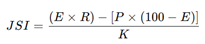
Where:
- PP = Politicization Score (0–100)
- EE = Coercive Efficacy Score (0–100)
- RR = Reciprocity Score (0–100)
- KK = Scaling factor (usually 100) to keep the final result in the 0–100 range
Explanation of the Formula’s Logic:
- (E×R)(E×R) – Positive Stability:
This part measures the system’s health. Coercive Efficacy (E) is the system’s capacity to enforce its decisions. Reciprocity (R) is social trust that the system is impartial. A system with high E and R is a functional system (Gesellschaft). Their product emphasizes that both are needed simultaneously – one without the other is insufficient.
- (100−E)(100−E) – The Coercive Weakness Factor:
This term inverts the Efficacy score. If E is high (a strong system), (100 – E) is low – the system is not vulnerable. If E is low (a weak system), (100 – E) becomes large – the system is fragile.
- P×(100−E)P×(100−E) – The Danger of Collapse:
This part penalizes the most toxic combination possible: High Politicization (P) together with Low Efficacy (E) (meaning a large (100 – E)). This describes a corrupt and incompetent oligarchic system (Gemeinschaft), which generates maximum resentment and a high risk of anarchy.
- Subtraction and Scaling:
We subtract the danger of collapse from the positive stability. The result is then divided by K (usually 100) to normalize the final score to the 0–100 range.
JSI Score Interpretation Grid:
| JSI Score | Structural Classification | State of Justice | National Security Risk |
| 80 – 100 | OPTIMAL GESELLSCHAFT | Independent arbiter; law is above purpose; high systemic trust. | Minimal. Institutional stability and attractiveness for investments. |
| 60 – 79 | FRAGILE GESELLSCHAFT | Pointual political pressures; justice still resists, but increasing vulnerabilities in some pillars (usually Politicization). | Moderate (Erosion). Risk of slow degradation if pressures are not countered. |
| 40 – 59 | OLIGARCHIC GEMEINSCHAFT IN ADVANCED FORMATION | Justice is the instrument of hierarchy; “Purpose” justifies means; enforcement is selective; trust is low. | High (Oppression/Soft Terror). System produces inequity and resentment, destabilizing social cohesion. |
| 20 – 39 | ANARCHY IN PROGRESS (WEAK STATE) | Laws are not systematically applied; sentences are often ignored; private justice flourishes. | Critical (Diffuse Violence). State monopoly on force is contested. Risk of localized civil conflicts. |
| 0 – 19 | TOTAL COLLAPSE / FAILED STATE | Law of the strongest; complete institutional dissolution of formal justice; chaos. | Maximum (Civil War/Generalized Chaos). Survival of the state as an entity is in doubt. |
7.4. Alarm Signals (Red Flags) Identified by JSI
Applying the JSI allows the identification of specific “Inflection Moments”:
- Collapse of Reciprocity: When I7 (Voluntary Compliance) falls below 40% and I8 (Accessibility) enters the red zone, while I1 (Rhetoric) is high.
- Shift from Law to Purpose: When I9 (Consistency) drops sharply (<50) concomitantly with an increase in I2 (Salami Slice Method).
- Critical Threshold of Anarchy: When I4 (Enforcement against the powerful) falls below 30%, signaling that the state no longer obeys its own courts.
8. Applied Case Studies: Validating the JSI
To demonstrate the heuristic utility and diagnostic capacity of the Judicial Stability Index (JSI), this section applies the model to three distinct typologies: a historical case of rapid and total collapse (Nazi Germany), a case of violent post-totalitarian transition (Romania 1989-1990), and a generic case of contemporary slow drift (the 21st-century illiberal model). The goal is not to provide perfectly quantified scores – precise historical data is lacking – but to show how the JSI indicators capture the essence of the degradation process in each context.
8.1. Historical Case: Germany, 1933-1935 – Collapse Through Total Capture
Period analyzed: From Hitler’s appointment as Chancellor (January 30, 1933) to the definitive consolidation of the dictatorship through the Nuremberg Laws (1935) and the explicit subordination of justice.
Estimated final JSI score: ≈12 (Total Collapse / Gemeinschaft of Terror).
Analysis by Pillars:
- Pillar I – Politicization (Estimated score: 95/100):
- Rhetoric of the “Purpose” (I1): Extreme and officialized. Reich Minister of Justice Franz Gürtner declared that “law is what serves the German people,” and Hitler that “the Führer’s will is the supreme source of law.” Judges were instructed to apply the law in a National Socialist spirit (Müller, 1991).
- Salami Slice Method (I2): Brutal and legislative. The Law for the Restoration of the Professional Civil Service (April 7, 1933) allowed the removal from office of all judges, prosecutors, and officials who were “non-Aryan” or with politically unreliable views. The purge was vast and rapid.
- Independence (I3): Destroyed. All appointments and promotions were controlled by the Reich Ministry of Justice, which acted on the party’s orders.
- Pillar II – Coercive Efficacy (Estimated score: 15/100):
- Enforcement of Sentences (I4): Totally selective. Sentences favorable to the regime or against its enemies (Jews, communists) were executed immediately. Sentences contradicting party or SA/SS interests were annulled by decrees or simply ignored. The Gestapo could take into “preventive custody” persons acquitted by ordinary courts (the case of Pastor Martin Niemöller).
- Parallel Justice (I6): Supreme. Special Courts (Sondergerichte) and later the People’s Court (Volksgerichtshof) for “treason” replaced ordinary justice for political cases. Acts of terror by the SA and SS often remained unpunished.
- Pillar III – Reciprocity (Estimated score: 5/100):
- Individual Protection: Non-existent. Punishment by analogy (Analogieschluss) was officially introduced – a person could be punished for an act not foreseen by law if “popular sentiment” considered it equivalent to a foreseen one. The nullum crimenprinciple was abandoned. The citizen was completely devoid of legal security.
- Accessibility and Trust: Justice became a privilege for the “people’s community” (Volksgemeinschaft). Those excluded from this community (Jews, opponents) lost any right to effective defense.
JSI Diagnosis: The system passed from a fragile Gesellschaft (Weimar Republic) to a totalitarian Gemeinschaft of terror in an interval of 2-3 years. The capture was total, rapid, and based on a radical transformation of the legal “software.” The near-zero score reflects the complete fusion of justice with the political oppression apparatus.
8.2. Case of Sudden Transition: Romania, December 1989 – January 1990 – Post-Totalitarian Anarchy
Period analyzed: The first weeks after the fall of the Ceaușescu regime.
Estimated final JSI score: ≈15 (Anarchy / Transitional Collapse).
Analysis by Pillars:
- Pillar I – Politicization (Estimated score: 90/100):
- Rhetoric of the “Purpose” (I1): Chaotic, revolutionary, but omnipresent. The concept of “Law” was replaced by the “Will of the Revolution.” The trial and execution of the Ceaușescu couple (December 25, 1989) were founded exclusively on the ethic of purpose: physical elimination for “saving the country” and the revolution. Public discourse was impregnated with the necessity of “cleansing” and “popular justice.”
- Salami Slice Method (I2): Violent and chaotic. There was no systematic method, but an institutional decapitation. The Securitate was disbanded, the prosecutor’s office and courts were paralyzed and under general suspicion. Many magistrates were marginalized or left the profession out of fear or shame.
- Pillar II – Coercive Efficacy (Estimated score: 10/100):
- Enforcement of Sentences (I4): Null for the old system, arbitrary for the new one. Civil courts were not functioning. The authority to make decisions with coercive force passed to the Council of the National Salvation Front (FSN), local revolutionary committees, and the army.
- Parallel Justice (I6): Maximum and violent. “Street justice,” lynchings (real or perceived), arbitrary arrests of former Securitate members, and informal popular “tribunals” were the main mechanisms of “justice.”
- Pillar III – Reciprocity (Estimated score: 5/100):
- Individual Protection: Non-existent for those labeled “Securitate members” or “crows.” There was no procedural framework guaranteeing them a fair trial.
- Trust in the Arbiter: Practically zero. The old judicial system was discredited as an instrument of the tyrant. No new legitimate arbiter was constituted. The population trusted the “street” and the new provisional power, not the courts.
JSI Diagnosis: The system passed directly from a totalitarian Gemeinschaft into a state of Revolutionary Anarchy. There was no phase of a consolidated new oligarchic Gemeinschaft, but a collapse of any institutionalized authority. The score reflects the complete absence of a functional judicial system. Justice as an institution temporarily ceased to exist, being replaced by brute force and chaotic collective will.
8.3. Contemporary Case: Generic State in Illiberal Drift – Oligarchic Gemeinschaft in Formation
Model: Inspired by processes in Hungary (post-2010), Poland (post-2015), Turkey (post-2010) or other states with tendencies of “state capture.”
Estimated final JSI score: ≈48 (Oligarchic Gemeinschaft in formation).
Analysis by Pillars:
- Pillar I – Politicization (Estimated score: 70/100):
- Rhetoric of the “Purpose” (I1): High and systematic. Sovereignist discourse is used: “the will of the people” (interpreted by the government) vs. “corrupt/sold-out magistrates serving foreign interests” or “privileged castes.” Laws are justified by “the need to protect national values” or to “make the system more efficient.”
- Salami Slice Method (I2): Subtle and legislative-institutional. Applied step by step: changing the retirement age to free up positions; altering the composition of judicial councils to control appointments; promoting “loyalists” to superior courts; using disciplinary procedures or inspections to harass independent judges.
- Hybrid Political Police: Using intelligence services or integrity agencies to “leak” compromising information to the press about resisting judges.
- Pillar II – Coercive Efficacy (Estimated score: 45/100):
- Enforcement of Sentences (I4): Inconsistent and selective. The state enforces sentences against the opposition or ordinary citizens rapidly, but blocks, delays, or refuses to enforce decisions against government projects, protected officials, or unfavorable European Court/ECHR rulings.
- Parallel Justice (I6): Bureaucratic. Judicial inspections or other oversight structures are transformed into “armed arms” of the executive to control the judiciary.
- Pillar III – Reciprocity (Estimated score: 40/100):
- Individual Protection: Eroded. Laws with vague terms (“national security,” “foreign agent”) are adopted, allowing arbitrary interpretations to harass opponents. The right to a fair trial is theoretical, but the risk of being targeted for political reasons increases.
- Accessibility (I8): Formal, but practically discouraged. Trials become extremely slow and costly, and the average citizen hesitates to sue the state for fear of reprisals or an inevitable unfavorable outcome.
JSI Diagnosis: The system is in the gray zone of Oligarchic Gemeinschaft. It is neither a functional Gesellschaft, nor anarchy. It is a state of institutional “slow necrosis.” The “hardware” (buildings, codes) exists, but the moral “software” (independence, spirit of the law) is altered. Justice becomes a protective barrier for elites allied with power and an instrument of pressure against dissidents. The critical threshold is reached: laws are applied only when they do not disturb the constituted power. The risk is of sliding either towards harder authoritarianism (if capture becomes total), or towards anarchy (if social resentment explodes and destroys even this corrupt justice).
Validation Conclusion: The JSI proves to be a robust analytical framework. It clearly distinguishes between different typologies and stages of collapse: rapid and total capture (Germany), chaotic post-totalitarian collapse (Romania ’89), and contemporary slow and systematic erosion (the illiberal model). Its indicators capture the key processes, offering a map to understand not only where a system is, but also on what trajectory it is heading.
9. General Conclusions and Implications for Resilience Policies
This paper had the dual aim of providing an integrative theory of the dynamics of judicial system collapse and building a practical diagnostic instrument for this process. By synthesizing the theoretical framework and the lessons extracted from case studies, we can draw clear conclusions regarding the nature, signs, and protection path of an institution fundamental to any society.
9.1. The Circular Trajectory of Justice: A Theoretical Synthesis
The research confirms the thesis that the judicial system follows a circular and predictable trajectory in relation to social cohesion:
- Beginning as an Instrument of Hierarchy (Original or Oligarchic Gemeinschaft): In state formation phases or in closed regimes, justice serves rather as a tool for crystallizing and imposing a hierarchical order.
- Apogee as Arbiter of the Law (Realized Gesellschaft): In periods of social equilibrium and consolidation of the rule of law, justice reaches its maximum potential, functioning as an impartial mechanism for applying abstract norms, generating systemic trust, and facilitating cooperation.
- Decline Through Capture and Politicization (Transition towards Oligarchic Gemeinschaft): Under the pressure of social polarization and oligarchic ambitions, justice is incrementally attacked (“Salami Slice Method”), loses its independence, and is transformed into an instrument for protecting the new power hierarchy. Reciprocity and trust erode.
- Functional Collapse as a Victim of Chaos (Anarchy): Either through the brutal collapse of the regime that had captured it, or through the total erosion of state authority, justice loses its last trace of social relevance. Laws become paper, and private force or the will of the crowd become the supreme arbiter.
This trajectory is not inevitable, but it is structural. It is determined not so much by the individual quality of magistrates, but by the macro-social balance between forces tending towards Gesellschaft (abstract individualism, contract, reciprocity) and those tending towards Gemeinschaft (rigid collective identity, hierarchy, supremacy of purpose).
9.2. Lessons for Resilience and Reconstruction Policies
Protecting the judicial system is not a technical-legal problem, but a profound socio-political one. The following practical implications emerge from our analysis:
1. The Supreme Priority: Defending Reciprocity.
Reciprocity (the state submitting to the same law it imposes) is the cornerstone. Any policy must be evaluated through the lens of its impact on this principle. Key actions include:
- Mandatory Enforcement of Sentences Against the State: Creating automated and transparent mechanisms for the immediate enforcement of such sentences. This is the strongest signal that the state respects the law.
- Effective Criminalization and Sanctioning of Political Interference in Justice: Not just in theory, but in practice. Coordinated media attacks against magistrates or subtle pressures must be recognized as serious crimes against the rule of law.
2. Combating the “Salami Slice Method” Through Proactive Mechanisms.
Slow capture must be prevented through institutions with built-in self-defense:
- Truly Independent Judicial Councils: Their composition must be guaranteed by mechanisms that exclude majoritarian political control (e.g., representation elected by magistrates, selection by lottery from a validated pool, participation of academia and civil society).
- Strengthened Functional Immunity and Security of Tenure: Forced retirements, disciplinary transfers, and removals must be nearly impossible, subject only to strict judicial control and extremely serious, proven reasons.
- Radical Transparency of Appointment and Promotion Processes: All candidacies, criteria, and decisions for superior judicial positions must be public and detailedly motivated.
3. Early Diagnosis and Alarm System.
Implementing an instrument like the Judicial Stability Index (JSI) at national and international levels (by the Venice Commission, EU, etc.) would allow:
- Objective Monitoring: Depoliticizing the debate about the state of justice by focusing on concrete indicators.
- Identifying Critical Thresholds: Establishing thresholds (e.g., Enforcement Rate <50%, Reciprocity Score <40) that trigger formal warnings and consolidated international verification procedures.
- Targeted Allocation of Resources and Support: To consolidate the weakest pillars in a given system.
4. Post-Crisis Reconstruction: More Than New Codes.
In states that have gone through anarchy or deep capture (post-totalitarian or post-conflict cases), reconstruction must primarily aim at rebuilding trust.
- Transitional Justice with Pedagogical Value: Trials for regime crimes must be models of procedural correctness, demonstrating to the public that there is a fundamental difference between the old (instrumental) and the new (impartial) justice.
- Intensive Civic and Legal Education: To change the mentality that “law is a tool” and promote the understanding that law is an individual’s shield against arbitrariness.
- Symbolic Cleansing of Institutions: Radical change of leadership personnel, names, and institutional rituals to mark a clear break with a corrupt or oppressive past.
9.3. Prognosis and Final Warning
Our model indicates that the major vulnerability of contemporary states, especially those in “illiberal drift,” is not the lack of laws, but the alteration of the ethic underlying their application. When a judge, a politician, or a citizen begins to ask “Who benefits from this law or this sentence?” instead of “Is this legal and correct?”, the software of Gesellschaft has been infected.
The critical alarm signals today are recognizable:
- Discourse that opposes “the will of the people” (interpreted by a leader or party) to “justice.”
- Adoption of special laws or ad-hoc procedural changes to influence a specific trial.
- The state’s persistent refusal to enforce judicial decisions that inconvenience it.
- Campaigns to denigrate constitutional courts or independent magistrates.
The lesson of the Venice Commission and history is clear: a state that subordinates its justice to a political “purpose,” however legitimate in the short term, undermines its own foundation of national security in the long term. It exposes itself either to the efficient tyranny of an oligarchy without checks, or to the anarchic revolt of a people that no longer has any legal way to defend its rights. Justice is not a luxury of democracy; it is its essential infrastructure. Protecting it is not a technical option, but an existential condition for the peace, prosperity, and freedom of any society that aspires to be, not just seem, modern.
Bibliography
- Acemoglu, D., & Robinson, J. A. (2019). The Narrow Corridor: States, Societies, and the Fate of Liberty.Penguin Press.
- Applebaum, A. (2003). Gulag: A History.
- Bánkuti, M., Halmai, G., & Scheppele, K. L. (2012). Disabling the Constitution. Journal of Democracy,23(3), 138-146.
- Bloch, M. (1940). Feudal Society(Vol. 1). University of Chicago Press.
- Dicey, A. V. (1885). Introduction to the Study of the Law of the Constitution.Macmillan and Co.
- Fukuyama, F. (1995). Trust: The Social Virtues and the Creation of Prosperity.Free Press.
- Fukuyama, F. (2011). The Origins of Political Order: From Prehuman Times to the French Revolution.Farrar, Straus and Giroux.
- Gambetta, D. (1993). The Sicilian Mafia: The Business of Private Protection.Harvard University Press.
- Garton Ash, T. (1997). The File: A Personal History.Random House.
- Habermas, J. (1996). Between Facts and Norms: Contributions to a Discourse Theory of Law and Democracy.MIT Press.
- Hayek, F. A. (1944). The Road to Serfdom.University of Chicago Press.
- Hobbes, T. (1651). Andrew Crooke.
- Iyengar, S., Lelkes, Y., Levendusky, M., Malhotra, N., & Westwood, S. J. (2019). The Origins and Consequences of Affective Polarization in the United States. Annual Review of Political Science,22, 129-146.
- Krygier, M. (2016). The Rule of Law: Pasts, Presents, and Two Possible Futures. Annual Review of Law and Social Science,12, 199-229.
- Luhmann, N. (1979). Trust and Power.John Wiley & Sons.
- Luhmann, N. (2004). Law as a Social System.Oxford University Press.
- Marshall, T. H. (1950). Citizenship and Social Class and Other Essays.Cambridge University Press.
- McCarthy, L. (2021). The Weaponization of Integrity Institutions in Illiberal Democracies.Carnegie Endowment for International Peace.
- McCoy, J., Rahman, T., & Somer, M. (2018). Polarization and the Global Crisis of Democracy: Common Patterns, Dynamics, and Pernicious Consequences for Democratic Polities. American Behavioral Scientist,62(1), 16-42.
- Merton, R. K. (1968). Social Theory and Social Structure.Free Press.
- Müller, I. (1991). Hitler’s Justice: The Courts of the Third Reich.Harvard University Press.
- Pech, L., & Scheppele, K. L. (2017). Illiberalism Within: Rule of Law Backsliding in the EU. Cambridge Yearbook of European Legal Studies,19, 3-47.
- Popper, K. (1945). The Open Society and Its Enemies.
- Rawls, J. (1971). A Theory of Justice.Harvard University Press.
- Rotberg, R. I. (Ed.). (2003). State Failure and State Weakness in a Time of Terror.Brookings Institution Press.
- Scheppele, K. L. (2018). Autocratic Legalism. University of Chicago Law Review,85(2), 545-583.
- Solzhenitsyn, A. I. (1973). The Gulag Archipelago 1918–1956.Harper & Row.
- Tönnies, F. (1887). Gemeinschaft und Gesellschaft.Fues’s Verlag.
Varol, O. O. (2017). The Democratic Coup d’État. Oxford University Press. - Vyshinsky, A. Y. (Ed.). (1938). The Law of the Soviet State.
- Weber, M. (1904). The Protestant Ethic and the Spirit of Capitalism.Scribner’s.


Leave a Reply