



M.Sc,; Psih. Eusebiu Jean TIHAN[1], M.Sc,, Psih.Laura Mihaela TIHAN[2]
eusebiu.tihan@gmail.com
[1] Romanian Academy of Scientists, https://orcid.org/0009-0008-8316-3679
[2] Tihan and Associates, https://orcid.org/0009-0003-1820-1417
Abstract
Objectives: This article aims to analyze the positioning and functioning of the Constitutional Court of Romania (CCR) through the lens of the extended triadic model of social integration: Anarchy (the absence of a constitutional arbiter), Gesellschaft (the court as a neutral and technical guardian of the constitution), and Oligarchic Gemeinschaft (the court as an instrument of political legitimization of power). The aim is to investigate how the political design of the appointment of constitutional judges and the legal-symbolic nature of its jurisprudence influence the role of the CCR as a factor of integration or institutional capture.
Method: The study applies a legal-political institutional analysis and a content analysis of case law. The methodology is qualitative, based on: (1) critical analysis of the mechanism for appointing CCR judges (Romanian Constitution, Law No. 47/1992) and their profiles; (2) case analysis of significant decisions from the post-2016 period, with a focus on controversies regarding justice, separation of powers, and fundamental rights; (3) assessment of the political system’s and public opinion’s reaction to CCR decisions; (4) theoretical integration of findings into the triadic hardware-software model.
Results: The research shows that the CCR is in a hybrid structural position, with a strong tendency to align with the Oligarchic Gemeinschaft. The appointment mechanism—through which the nine judges are appointed by the executive and legislative branches (three by the Senate, three by the Chamber of Deputies, and four by the President of the Republic)—is a hybrid of the presidential and parliamentary systems.
Keywords: Constitutional Court Capture, Judicial Independence, Constitutional Legitimacy, Gesellschaft, Gemeinschaft, Comparative Constitutional Law, Romania, Venice Commission.
Tribunalul legitimării: Curtea Constituțională a României în triada anarhie – gesellschaft – gemeinschaft
Rezumat
Obiective: Acest articol își propune să analizeze poziționarea și funcționarea Curții Constituționale a României (CCR) prin prisma modelului triadic extins al integrații sociale: Anarhie (absența unui arbitru constituțional), Gesellschaft (tribunalul ca gardian neutru și tehnic al constituției) și Gemeinschaft Oligarhic (instanța ca instrument de legitimare politică a puterii). Scopul este de a investiga modul în care designul politic al numirii judecătorilor constituționali și natura juridic-simbolică a jurisprudenței sale influențează rolul CCR ca factor de integrare sau de captură instituțională.
Metodă: Studiul aplică o analiză instituțională juridic-politică și o analiză de conținut a jurisprudenței. Metodologia este calitativă, bazată pe: (1) analiza critică a mecanismului de numire a judecătorilor CCR (Constitutia României, Legea nr. 47/1992) și a profillului acestora; (2) analiza de caz a unor decizii semnificative din perioada post-2016, cu accent pe controverse privind justiția, separarea puterilor și drepturile fundamentale; (3) evaluarea reacției sistemului politic și a opiniei publice la deciziile CCR; (4) integrarea teoretică a constatărilor în modelul triadic hardware-software.
Rezultate: Cercetarea demonstrează că CCR se află într-o poziție structurală hibridă, cu o tendință puternică de aliniere la Gemeinschaft Oligarhic. Mecanismul de numire – prin care cei 9 judecători sunt desemnați de puterile politice executive și legislative (3 de Senat, 3 de Camera Deputaților, 3 de Președinte) fără o filtrare profesională sau consensuală suficientă – transformă instanța într-un echilibru al intereselor politice, nu într-un bastion al independenței. Analiza jurisprudenței relevă un model de activitate selectivă: pasivitate și formalism în cazurile care afectează interesele majorității politice (e.g., nepunerea în mișcare a mecanismului de suspendare a Președintelui în 2012), combinate cu activism judiciar în sprijinul agendei puterii (e.g., deciziile ce au slăbit mecanismele de luptă anticorupție). CCR funcționează astfel mai degrabă ca un „tribunal al legitimării”, oferind acoperire constituțională și formală pentru mutațiile politice ale rețelei oligarhice.
Concluzii: Articolul concluzionează că, în ciuda statutului său formal de garant suprem al constituției, CCR riscă să devină un pilon al capturii constituționale în loc să fie zidul împotriva ei. Eficacitatea sa ca instituție Gesellschaft este erodată de captura sa politică de origine. Pentru a-și recăpăta rolul autentic, este necesară o reformă radicală a mecanismului de selecție a judecătorilor, orientată către profesionalizare, transparență și consens social larg. Studiul subliniază că, într-o democrație sub presiune, cea mai înaltă instanță de justiție constituțională poate fi, paradoxal, prima care capitulează, transformându-se dintr-un control al puterii într-un instrument al acesteia.
Declarație de Semnificație Publică: Curtea Constituțională este adesea percepută ca o arenă tehnică și înaltă, departe de preocupările cotidiene. Această analiză demonstrează că deciziile sale sunt centrale pentru soarta democrației. Atunci când CCR devine un instrument de legitimare a majorității politice de moment în loc să fie un arbitru imparțial al regulilor fundamentale, ea subminează chiar fundația pactului social. Prin demascarea modului în care designul politic al numirilor și jurisprudența selectivă pot transforma garantul suprem al constituției într-un actor partizan, acest articol oferă cetățenilor, jurnaliștilor și juriștilor un cadru esențial pentru a evalua nu doar ce decide CCR, ci de ce și în cui interes decide. El avertizează că protejarea statului de drept necesită vigilență asupra tuturor puterilor statului, inclusiv asupra aceleia care ar trebui să le limiteze pe celelalte.
Cuvinte cheie: Captură constituțională, Curtea Constituțională a României, Gemeinschaft Oligarhic, Gesellschaft, justiție constituțională, model triadic, numire politică, oligarhie, stat de drept, teorie instituțională.
CUNOAȘTEREA ȘTIINȚIFICĂ, Volumul 5, Numărul 4, Decembrie 2026, pp. xxx
ISSN 2821 – 8086, ISSN – L 2821 – 8086, DOI: 10.58679/CS50091
URL: https://www.cunoasterea.ro/en/from-guardian-to-instrument-a-comparative-analysis-of-constitutional-court/
© 2026 Eusebiu Jean TIHAN, Laura Mihaela TIHAN. Responsabilitatea conținutului, interpretărilor și opiniilor exprimate revine exclusiv autorilor.
CC BY 4.0 License
1. INTRODUCTION: THE PERENNIAL DILEMMA OF CONSTITUTIONAL ADJUDICATION
In the architecture of the modern state, the constitutional court occupies a singular and supreme position. It is the custodian of the constitutional discourse, the final arbiter of the coherence between state action and the fundamental norm (Stone Sweet, 2000). In the pure theory of Gesellschaft, it represents the apotheosis of “normative software”: a supreme, technical, impersonal institution adjudicating conflicts based on abstract rules and superior legal reasoning, thereby guaranteeing the predictability and stability of the entire system. Its role is to safeguard the fundamental “rules of the game” against the opportunistic tendencies of temporary political actors.
However, this very supreme role makes it a prime target for forces aspiring to state capture. Unlike an ombudsman, whose decisions often have a moral or administrative impact, a constitutional court’s rulings possess supreme legal force with the immediate effect of blocking or validating the actions of the Parliament, the Government, and even other courts. Control over this institution offers an emerging oligarchy its most potent instrument: the capacity to “constitutionalise” its own interests, transforming particular political preferences into supreme, ostensibly neutral, and definitive legal norms. Thus, a constitutional court risks becoming not the guardian of the constitution against abuses, but the guardian of abuses against the authentic constitution.
This fundamental tension is not unique to any single jurisdiction but represents a central pathology in contemporary constitutional design, particularly evident in post-communist democracies. The comparative literature on “constitutional backsliding” or “illiberal democracy” highlights how capturing the judiciary, especially the constitutional court, is a critical step in dismantling checks and balances (Bánkuti, Halmai, & Scheppele, 2012; Pech & Scheppele, 2017). While cases like Poland and Hungary demonstrate overt and rapid assaults on judicial independence, other states may experience a more gradual, insidious erosion through ostensibly legal means.
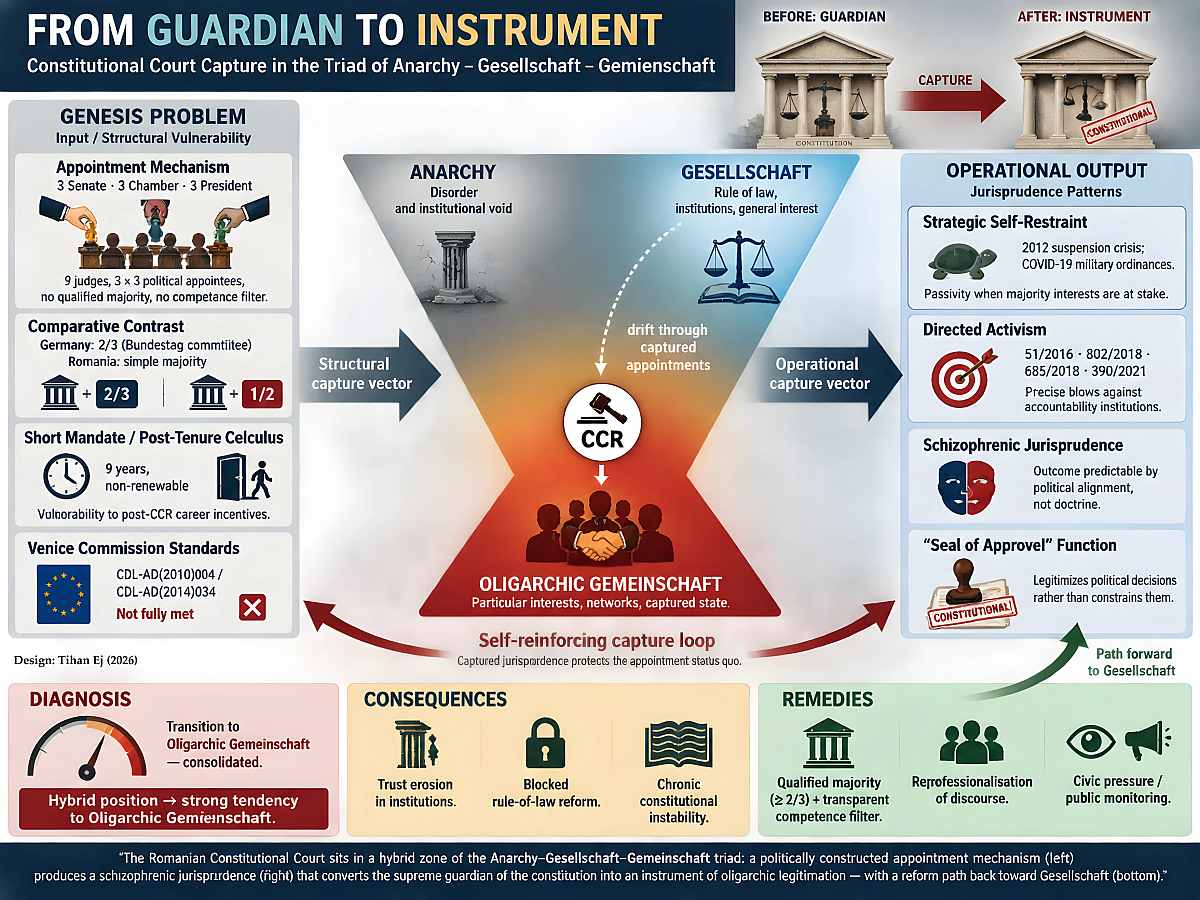
This article analyses this tension through the case of the Romanian Constitutional Court (Curtea Constituțională a României, CCR). It asks: does the CCR function as the final guarantor of the rule of law (Gesellschaft), or has it become a sophisticated mechanism for the legal legitimisation of an oligarchic Gemeinschaft? We examine this dilemma through two primary lenses: (1) the genesis of the institution—the procedure for appointing constitutional judges—and (2) its operational output—its jurisprudence in politically sensitive cases. The analysis is framed within an original triadic model (Anarchy – Gesellschaft – Gemeinschaft Oligarchic), providing a diagnostic tool for assessing the legitimacy and independence of constitutional adjudication.
The article’s significance lies in its dual contribution: first, it offers a rigorous, theory-driven diagnosis of a critical yet under-scrutinised institution in a key EU member state. Second, by placing the Romanian case in a comparative context and utilising a novel analytical framework, it provides a template for analysing similar vulnerabilities in other constitutional democracies. The structure is as follows: Section 2 elaborates the triadic theoretical framework. Section 3 dissects the CCR’s appointment mechanism as a vector for potential political capture. Section 4 presents a qualitative case study of the CCR’s jurisprudence in key post-2016 political controversies. Section 5 synthesises the findings to diagnose the CCR’s position within the triad. Finally, Section 6 draws comparative conclusions and discusses implications for constitutional design and the resilience of the rule of law.
1.1 Methodological Positioning and Epistemological Limitations
This analysis is based on a qualitative and interpretative methodology, with the primary aim of generating theoretical insight and diagnosing a complex institutional problem, rather than statistically testing hypotheses. It integrates three complementary approaches:
- Critical Analysis of the Institutional Framework: The legal-formal examination of the appointment mechanism (through the Constitution and organic law) is combined with an assessment of the political logic and systemic consequences embedded in this design. This analysis is not limited to the normative text but interprets it within the context of power dynamics.
- Qualitative Case Study of Jurisprudence: The selection and examination of certain emblematic CCR decisions (e.g., Decisions No. 51/2016, 802/2018, 390/2021) does not seek exhaustive quantification but aims to highlight revealing patterns of judicial behaviour. The purpose is to illustrate how the structural vulnerabilities identified in the theoretical framework manifest in practice. The selection of cases is justified by their landmark character, the intensity of public debate they generated, and their clear exemplification of phenomena such as “directed activism” or “strategic self-restraint.”
- Theoretical Integration into the Triadic Model: Empirical findings are synthesised and evaluated through the prism of the triadic model (Anarchy – Gesellschaft– Gemeinschaft), which serves as a heuristic framework for diagnosis. This model is not a rigorous predictive apparatus but a conceptual instrument for describing ideal-typical states, identifying trends, and providing a coherent narrative of an institutional evolution.
The epistemological limitations of this approach are explicitly acknowledged:
- Interpretative Nature: Attributing specific motivations or a particular political logic from the analysis of legal texts and their context inevitably involves a degree of interpretation. This research assumes this critical perspective and supports it through source triangulation (official documents, academic analyses, civil society reports).
- Case Selection and Generalisation: The case study, by its nature, focuses on paradigmatic examples. While these are decisive for demonstrating the existence of a phenomenon and a pattern, they cannot claim to exhaustively represent the CCR’s entire activity. The generalisation consists in identifying a systematic logic of operation, not in quantifying its exact proportion.
- The Theoretical Framework as a Lens: The triadic model is consciously used as a focusing lens. It highlights certain aspects (legitimacy, political vs. legal logic) and leaves others in the shade (administrative efficiency, the technical complexity of reasoning). Its value lies in its ability to organise observations into a fruitful explanatory framework, while acknowledging that other models could offer different, though not necessarily contradictory, perspectives.
Therefore, this study aims to provide a grounded theoretical diagnosis, capable of debating the pathological effects of a particular institutional design and placing a national case within a broader comparative debate, without claiming total empirical exhaustiveness or positivist objectivity. Its strength resides in its capacity to connect social theory, legal analysis, and political observation to explain a crisis of constitutional legitimacy.
2. Theoretical Framework: Constitutional Adjudication in the Triad of Anarchy – Gesellschaft – Gemeinschaft
The function of constitutional review can be conceptualised as evolving among three ideal-typical states, reflecting the maturity and integrity of a political system.
- Anarchy (The State of Nature / Absence of Control): In this state, there is no dedicated constitutional review body, or it is completely inoperative. Conflicts between powers or between the state and the citizen are resolved through force, influence, or opaque political negotiations. The constitution is a decorative document, and its violation carries no sanctionable legal consequences. This is the pre-constitutional state or the state of a collapsed rule of law.
- Gesellschaft (The Tribunal as a Technical and Neutral Arbiter): Here, the Constitutional Court achieves its Kelsenian ideal as the “guardian of the constitution” (Kelsen, 1942). Its characteristics are:
- Radical Independence: Judges are appointed through procedures that maximise independence from the executive and legislative powers, often involving qualified majorities, roles for the legal community, and long, non-renewable terms.
- Legitimation Through Expertise: The primary search is for elite professionals in constitutional law—university professors, experienced judges—whose authority derives from competence, not political affiliation.
- Pro-Rights and Pro-Procedural Activism: The court is active in protecting fundamental rights and the separation of powers, intervening against abuses regardless of the author. Its reasoning is predominantly formal-procedural and principled.
- Visibility and Moral Authority: Its decisions are respected by all political actors, even when inconvenient, because its authority is perceived as deriving from law, not factional will.
- Gemeinschaft Oligarchic (The Tribunal as an Instrument of Legitimation): In this pathological state, the Constitutional Court suffers a subversion of its function. From a control onpower, it becomes a tool of Its characteristics become:
- Capture of the Appointment Process: Judges are appointed on clear political criteria, based on loyalty to the proposing parties or groups. Each political power installs its own “representatives” on the bench.
- Legitimation Through Political Representation, Not Expertise: The court’s composition becomes a balance of political forces. The appointment of individuals without relevant judicial or academic careers signals this logic.
- Schizophrenic and Strategic Jurisprudence: Decisions become unpredictable in principle but predictable politically, exhibiting selective activism to serve the majority’s agenda and strategic self-restraint in cases that could challenge it.
- The “Seal of Approval” Function: Its primary role becomes to provide constitutional cover and legal legitimacy for the contested political actions of the ruling majority.
The transition between states is often a drift, determined primarily by the capture of the appointment mechanism. The following chapter focuses on this critical mechanism in the case of Romania.
3. The Appointment Mechanism – A Genesis Problem: When the Tribunal is Created by the Parties
The procedural design for selecting constitutional court judges is not a technical detail; it is the constitutive act that largely predetermines the institution’s future operational logic. In constitutional theory, this mechanism should ensure dual legitimacy: a democratic one, through a connection to elected powers, and an expert one, through a guarantee of competence and independence (Ferejohn, 2002). In a Gesellschaft model, this balance is maintained through institutional firewalls that separate appointments from day-to-day partisan politics.
In Romania, the appointment mechanism, regulated by the Constitution (Art. 140) and Law No. 47/1992, structurally encourages political capture. A comparative analysis reveals its congenital vulnerability when measured against European standards. The Venice Commission, in its reports on judicial independence, consistently emphasises that appointment procedures should “prevent any over-concentration of influence in a single state body” and ensure that candidates “are chosen on the basis of proven competence and integrity” (Venice Commission, 2010, CDL-AD(2010)004, paras. 55-60). The Romanian system deviates from these principles in several key aspects:
- Exclusively Political Distribution of Appointment Power: The nine judges of the CCR are appointed exclusively by the three main political branches, with no formal role for the judiciary or the legal academy: three by the Chamber of Deputies, three by the Senate, and three by the President of Romania. This distribution a prioritransforms the CCR into a terrain for representing political interests. Each power installs its own “delegates,” creating a dynamic where a judge may feel more like a representative of the appointing institution than a member of an impartial collegiate body. This stands in contrast to models like the German Federal Constitutional Court, where half the judges are elected by a special committee of the Bundestag (requiring a two-thirds majority, thus forcing inter-party consensus) and the other half by the Bundesrat, with a strong (though not exclusive) emphasis on professional judicial and academic credentials (Kommers & Miller, 2012).
- Absence of Qualified Majorities and Competence Filters: Appointment requires only a simple majority of present members in each parliamentary chamber. This allows the dominant party or coalition in each house to install its preferred candidate without seeking broad consensus with the opposition. There is no qualified majority (e.g., two-thirds) that would force negotiation and the selection of a candidate with uncontested authority—a common feature in systems designed to foster consensus, such as in Austria or, partially, in Italy. Furthermore, there is no transparent competence verification process. While the law requires judges to be “eminent representatives of legal science,” this vague condition is interpreted politically. Consequently, individuals with overt political careers—former ministers, presidential advisors—have repeatedly been appointed to the CCR, often with marginal or contested academic or judicial credentials. This shifts the court’s nature from a tribunal of experts to a council of political representatives.
- The Short Mandate and Post-Tenure Calculus: The nine-year, non-renewable term seems robust. However, its effectiveness is compromised by two aspects: (a) its relative brevity within a career, making political pressures more relevant for a judge’s post-CCR prospects; (b) paradoxically, absolute non-renewability can create a logic of final obedience—a judge nearing the end of a mandate and seeking a future position may be more susceptible to external influence. The Venice Commission (2014) notes that while non-renewability is positive, a mandate of at least 12 years is preferable to further insulate judges from political cycles (CDL-AD(2014)034, para. 73).
This constitutional design embodies an original contradiction: it demands that a court be the supreme arbiter of the democratic game, yet it creates that court directly from the parties involved in the game. This places it in a permanent hybrid position with a strong tendency towards Gemeinschaft, as its operational logic is impregnated from the outset by political calculus. The comparative lesson is clear: appointment systems based on simple majoritarian logic within politically elected bodies, without robust consensus-building mechanisms or independent expert vetting, create a systemic vulnerability to capture, as evidenced in other regional contexts like Poland after 2015 (Pech & Scheppele, 2017).
4. Case Study: CCR Jurisprudence – Between Formalism and Partisanship
To test whether this structural vulnerability materialises in practice, we examine the CCR’s jurisprudence in highly sensitive political-constitutional cases from the past decade. The analysis reveals a pattern confirming a transition towards the role of legitimiser for an oligarchic Gemeinschaft. This “schizophrenic jurisprudence”—oscillating between strategic passivity and directed activism—mirrors patterns observed in other captured courts, though often with distinct legalistic camouflage.
Case 1: The 2012 Crisis – Strategic Self-Restraint.
During the suspension of President Băsescu and the subsequent referendum validated by the CCR, the court refused to rule on the legality of the suspension procedure itself, limiting itself to narrow procedural aspects of the referendum. This judicial self-restraint during a profound constitutional crisis was widely interpreted as a lack of courage to verify the actions of a strong parliamentary majority, preferring to leave the solution to raw politics. It is a prime example of strategic passivity that serves the power status quo, characteristic of a court captured by a dominant political force seeking to avoid scrutiny—a tactic also seen in the early stages of constitutional erosion elsewhere.
Case 2: Erosion of the Justice System (Post-2017) – Directed Activism.
In this domain, the CCR demonstrated consistent and predictable legal activism in service of the political agenda of the governing PSD-ALDE/PNL coalition. Its decisions created institutionalised legal instability, systematically weakening anti-corruption and judicial independence frameworks:
- Decision No. 51/2016 invalidated the Criminal Code, triggering a legislative crisis.
- Decision No. 802/2018 ruled that the head of the National Anticorruption Directorate (DNA) must be appointed by the Minister of Justice, undermining prosecutorial independence.
- Decision No. 685/2018 on judicial incompatibilities was used to attack the Special Section for Investigating Magistrates.
- Decision No. 390/2021 invalidated key provisions of the magistrates’ statute law, fuelling uncertainty.
This series of decisions, accompanied by aggressive public rhetoric from some constitutional judges against magistrates (labelling them a “parallel state”), illustrates the model of directed activism. The CCR acted not as a stabilising regulator but as a political actor delivering precise blows to institutions threatening the oligarchic core—in this case, an independent judiciary investigating high-level corruption. This aligns with a broader regional pattern where captured constitutional courts actively dismantle accountability mechanisms, akin to the Polish Constitutional Tribunal’s rulings undermining the independence of the Supreme Court (Sadurski, 2019).
Case 3: The COVID-19 Pandemic – Deference and Executive Power Expansion.
During the state of emergency, the CCR adopted a position of extreme deference to the Government, rejecting almost all constitutional challenges raised against military ordinances. While some deference may be justified in a crisis, the lack of effective control over measures with a profound impact on fundamental rights demonstrated an inclination to cover and legitimise the expansion of executive power by the ruling majority. This reflects a common trend where courts in captured systems abdicate their role as rights guardians during crises, granting carte blanche to the executive (Scheppele, 2020).
Partial Conclusions
This jurisprudence does not denote a neutral court. It denotes a court whose decisions are predictable based on the political alignment of the case. When a case threatens oligarchic interests (an independent judiciary), the CCR becomes activist and disruptive. When a case challenges the abuses of a strong majority, it becomes passive, formalist, or deferent. This schizophrenic behaviour is the hallmark of a captured court that has internalised the logic of the oligarchic Gemeinschaft: protecting the network is prioritised over defending impersonal constitutional principles.
5. BEHAVIOURAL MODELS AND TRIADIC DIAGNOSIS: THE POSITIONING OF THE CCR WITHIN THE THEORETICAL TRIAD
Synthesising the structural and jurisprudential analysis, we can precisely describe the positioning of the Romanian Constitutional Court within the three states of the triadic model. This diagnosis is not static, but reflects a trajectory and institutional dynamic with profound implications for the viability of Romanian democracy.
- In Anarchy/Collapse: In this state, the Constitutional Court is non-existent or completely marginalised. Its decisions are ignored by the de factopowers, and the constitution becomes a decorative document without coercive force. Unlike collapsed states (e.g., some failed states), Romania is not in this state. The CCR is constantly invoked and its decisions are, formally, respected. However, the risk of regression towards anarchy is real when the moral authority of the court is eroded to the point where respect for its decisions becomes a simulacrum, preserving only the form, but not the substance. An indication of this risk is the acrimonious public dispute among its own judges, which transforms legal deliberation into a visible political quarrel, undermining the unity and authority of the court.
- In Gesellschaft (Functional): Here, the CCR would be the principled and stabilising arbiter. Its characteristics would be:
- Perceived Independence: Its decisions are respected for its legal and moral authority, not for the political force behind them.
- Doctrinal Consistency: Jurisprudence is predictable based on established principles, not on the momentary political context.
- Guardian of Rights and the Separation of Powers: It intervenes firmly to protect the rights of minorities and the institutional balance against the hegemonic tendencies of any power.
- Visibility as Moral Authority: It is seen by citizens and political classes as the last bastion of legal reasoning and constitutional spirit.
Comparatively, the German Federal Constitutional Court approaches this ideal, building an authority that derives largely from the consistency of its doctrine and the perception of impartiality (Kommers & Miller, 2012). In Romania, these characteristics are weakened or absent.
- In Gemeinschaft Oligarchic (Captured): “The Tribunal of Legitimation” with Schizophrenic Behaviour. This is the zone in which the CCR predominantly operates. Its characteristics are:
- Political Predictability: The outcome of an important case can be anticipated based on who wins and who loses from the perspective of the power network.
- Situational Jurisprudence: Decisions are justified by formal legal reasoning, but the selection of cases in which it intervenes and the direction of the intervention follow a political logic.
- Instrument of Confrontation: It is used as a weapon in political struggle, to invalidate acts of the opposition or to legitimise controversial acts of the majority.
- Erosion of Authority: It gradually loses its status as a neutral authority in the eyes of a significant part of the public and the legal community.
- The “Seal of Approval” Function: Its primary role becomes to provide a notice of “constitutional conformity” to the actions of the elite, transforming political dispute into apparent legal certainty.
Diagnosis for the Romanian CCR: The institution is clearly in the zone of transition towards Gemeinschaft Oligarchic, with consolidated tendencies in this direction. The political appointment process has produced a composition that reflects political divisions, not unity around the constitution. The selective and partisan jurisprudence has confirmed that this structural capture has serious operational consequences. The CCR is no longer the guardian of the constitution against politics, but has become an arena where politics is disputed with constitutional weapons, where often the one who controls the numerical majority in the court wins.
A profound psychological aspect of this capture is that it does not always operate through direct dictate. It functions through a corruptible legal rationality – the capacity to produce sophisticated technical arguments which, clothed in constitutional formalism, serve a particular political purpose. This “politicised technocracy” is more dangerous than the pure ignoring of the law, because it is harder to dismantle and offers an appearance of legitimacy that deceives and fatigues the citizen’s critical spirit.
Conclusions – From Guardian to Instrument: The Crisis of Constitutional Legitimation and the Path Forward
The capture of a Constitutional Court represents the highest point of democratic subversion. It is not just the corruption of an institution, but the corruption of the system’s supreme self-correction mechanism. When the tribunal that should be the last defence against the tyranny of the majority becomes an instrument of it, the rule of law enters an induced state of coma. For Romania, the situation of the CCR is a red alarm signal indicating that institutional capture has penetrated the supreme sanctuary of legal legitimation.
Comparative Implications and Implications for Democratic Viability:
The Romanian case is not isolated, but part of a regional pattern of “illiberal resistance” within the EU (Pech & Scheppele, 2017). Unlike the “legal revolution” in Poland or Hungary, which was rapid and frontal, the mechanism in Romania has been more gradual and better hidden in legal formalism. This makes it, in a certain sense, more insidious. The effects are devastating:
(1) a systemic crisis of trust in justice, which spills over into the entire social edifice;
(2) the blocking of any real reform of the rule of law, which can be annulled by a CCR decision;
(3) chronic constitutional instability, where the fundamental rules of the democratic game are fluid and surrendered to permanent political negotiation.
The way out is arduous, because it involves changing the rules that favour precisely those who should change them. It requires a multidimensional approach that goes beyond purely legal remedies:
- Radical Reform of the Appointment Mechanism: This is the sine qua non The model must migrate from majoritarian political representation towards legitimation through expertise and consensus. Concrete solutions include introducing a qualified majority (minimum 2/3) for each appointment in Parliament, forcing negotiation and the selection of a candidate with uncontested authority. In addition, the creation of a transparent competence filter, managed by a mixed parliamentary-academic commission, which would publicly evaluate the professional qualifications of candidates, in the spirit of the Venice Commission’s recommendations.
- Reprofessionalisation of Discourse and Practice: The CCR must regain its status as a forum of legal reasoning, not of political struggle. This implies extreme internal self-discipline and public communication that reaffirms principled consistency and independence from external pressures. The national and international legal community has a crucial role in maintaining this standard through public critical analysis.
- Public Awareness and Civic Pressure as Collective Therapy: Here intervenes the fundamental psychological dimension. It is essential that society understands that the battle for an independent CCR is not a technical dispute, but the battle for the psychological constitution of the community. It is the fight to preserve a common mental space where rules are stable and applied impartially, the basis of any trust and social cooperation. The monitoring and public denunciation of political appointments and partisan decisions must become a priority for the independent press and civil society, not as an act of accusation, but as a therapeutic act of strengthening social immunity.
In conclusion, the Romanian Constitutional Court is more than a court; it is a mirror of the state of our democracy and of the psychological health of the body politic. It reflects not an abstract ideal, but the reality of a struggle for power in which the rules are permanently negotiated by those who should defend them. Its recovery as a true guardian of Gesellschaft is not a technical option; it is an existential condition for the viability of the Romanian democratic project. Without a credible arbiter of the fundamental rules, social trust dissolves, and the future becomes a terrain of unpredictable confrontation, not a collective project. The recovery of the CCR begins with the understanding of this true urgency.
BIBLIOGRAPHY
- Theoretical Sources and Analyses of Comparative Constitutional Law:
- Bánkuti, M., Halmai, G., & Scheppele, K. L. (2012). Hungary’s Illiberal Turn: Disabling the Constitution. Journal of Democracy, 23(3), 138–146. https://doi.org/10.1353/jod.2012.0054
- Ferejohn, J. (2002). Judicializing Politics, Politicizing Law. Law and Contemporary Problems, 65(3), 41–68.
- Kelsen, H. (1942). Judicial Review of Legislation: A Comparative Study of the Austrian and the American Constitution. The Journal of Politics, 4(2), 183–200. https://doi.org/10.2307/2125770
- Kommers, D. P., & Miller, R. A. (2012). The Constitutional Jurisprudence of the Federal Republic of Germany (3rd ed.). Duke University Press.
- North, D. C., Wallis, J. J., & Weingast, B. R. (2009). Violence and Social Orders: A Conceptual Framework for Interpreting Recorded Human History. Cambridge University Press. https://doi.org/10.1017/CBO9780511575839
- Pech, L., & Scheppele, K. L. (2017). Illiberalism Within: Rule of Law Backsliding in the EU. Cambridge Yearbook of European Legal Studies, 19, 3–47. https://doi.org/10.1017/cel.2017.9
- Sadurski, W. (2019). Poland’s Constitutional Breakdown. Oxford University Press. https://doi.org/10.1093/oso/9780198840503.001.0001
- Scheppele, K. L. (2020). The Opportunism of Populists and the Defense of Constitutional Democracy. German Law Journal, 21(2), 314–331. https://doi.org/10.1017/glj.2020.27
- Stone Sweet, A. (2000). Governing with Judges: Constitutional Politics in Europe. Oxford University Press. https://doi.org/10.1093/acprof:oso/9780198297307.001.0001
- Tönnies, F. (2001). Community and Civil Society (J. Harris, Trans.). Cambridge University Press. (Original work published 1887).
- International Documents and Reports:
- European Commission for Democracy through Law (Venice Commission). (2010). Report on the Independence of the Judicial System – Part I: The Independence of Judges. Study No. CDL-AD(2010)004. https://www.venice.coe.int/webforms/documents/default.aspx?pdffile=CDL-AD(2010)004-rin
- Venice Commission. (2014). Report on the Selection and Appointment of Judges. Study No. CDL-AD(2014)034. https://www.venice.coe.int/webforms/documents/default.aspx?pdffile=CDL-AD(2014)034-e
- Analyses on the Romanian Case (Secondary Sources):
- Iancu, B. (2012). Perils of Semi-Presidentialism. The Romanian Constitutional Regime. Romanian Journal of Comparative Law, 3(1), 1–48.
- Mungiu-Pippidi, A. (2018). Romania’s Italian-style Anticorruption Populism. Journal of Democracy, 29(3), 104–116. https://doi.org/10.1353/jod.2018.0045
- Popa, N. (2021). Politicizarea justiției constituționale în România postcomunistă: O analiză a mecanismului de numire a judecătorilor CCR [The Politicisation of Constitutional Justice in Post-Communist Romania: An Analysis of the CCR Judge Appointment Mechanism]. Revista Română de Științe Politice, 21(1), 47–68.
- Ștefan, L. (2020). Captura constituțională: Cum este subminată independența Curții Constituționale a României [Constitutional Capture: How the Independence of the Romanian Constitutional Court is Undermined]. In G. Bădescu & P. Sum (Eds.), *Romania 30: Three Decades of Post-communist Transition* (pp. 123–145). Peter Lang. https://doi.org/10.3726/b16390
- Voicu, O. (2019). Între gardian și instrument: Curtea Constituțională în dezbaterea publică românească [Between Guardian and Instrument: The Constitutional Court in Romanian Public Debate]. Report, Centrul pentru Resurse Juridice (CRJ). Bucharest.
- Primary Sources (Romanian Legislation and Jurisprudence):
- Constituția României, revizuită [The Constitution of Romania, revised]. Monitorul Oficial al României, Partea I, Nr. 767 din 31 octombrie 2003, cu modificările și completările ulterioare.
- *Legea nr. 47/1992 privind organizarea și funcționarea Curții Constituționale a României*, republicată [Law No. 47/1992 on the Organisation and Functioning of the Romanian Constitutional Court, republished]. Monitorul Oficial al României, Partea I, Nr. 82 din 30 ianuarie 2023.
- Curtea Constituțională a României. (2016). *Decizia nr. 51/2016* [Decision No. 51/2016]. Monitorul Oficial al României, Partea I, Nr. 246 din 31 martie 2016.
- Curtea Constituțională a României. (2018). *Decizia nr. 685/2018* [Decision No. 685/2018]. Monitorul Oficial al României, Partea I, Nr. 1004 din 28 noiembrie 2018.
- Curtea Constituțională a României. (2018). *Decizia nr. 802/2018* [Decision No. 802/2018]. Monitorul Oficial al României, Partea I, Nr. 1095 din 21 decembrie 2018.
- Curtea Constituțională a României. (2021). *Decizia nr. 390/2021* [Decision No. 390/2021]. Monitorul Oficial al României, Partea I, Nr. 462 din 10 mai 2021.
- Monitoring Reports and Socio-Political Analysis:
- Expert Forum (EFOR). (2021). Raport anual privind starea democrației în România [Annual Report on the State of Democracy in Romania]. Bucharest.
- Freedom House. (2023). Nations in Transit: Romania Country Report 2023. https://freedomhouse.org/country/romania/nations-transit/2023
- RISE Project. (2018). Who Judges the Judges? The Political Connections of Romania’s Constitutional Court Judges [Investigative Report].
Tihan, Eusebiu Jean; Tihan, Laura Mihaela (2026) From Guardian to Instrument: A Comparative Analysis of Constitutional Court Capture Through the Triadic Lens of Anarchy, Gesellschaft, and Gemeinschaft, Cunoașterea Științifică, 5:4, DOI: 10.58679/CS50091, https://www.cunoasterea.ro/en/from-guardian-to-instrument-a-comparative-analysis-of-constitutional-court/




Leave a Reply