



 Sfetcu, Nicolae (2025), The Evolution of Global Warming: Tipping Points, Human Inaction, and Future Scenarios, Cunoașterea Științifică, 4:4, 7-20, DOI: 10.58679/CS49550, https://www.cunoasterea.ro/the-evolution-of-global-warming/
Abstract
Global warming is an unequivocal reality, and overwhelming scientific evidence attributes this rapid climate change to human activities. Since the Industrial Revolution, humans have poured billions of tons of carbon dioxide (CO₂) and other greenhouse gases into the atmosphere, trapping heat and raising Earth’s temperature at an unprecedented rate. The scientific consensus is clear: human-induced climate change is real, measurable, and accelerating, and its potential consequences pose profound challenges for the future of civilization. On one path, humanity manages to unite in an unprecedented effort to cut emissions, protect ecosystems, and innovate towards sustainability – in time to avert the worst outcomes. On the other, we continue with half-hearted measures and discord, thereby forfeiting our last chance to keep climate change within controllable bounds.
Keywords: global warming, climate change, tipping points, human inaction, future scenarios
Evoluția încălzirii globale: puncte de basculare, inacțiunea umană și scenarii viitoare
Rezumat
Încălzirea globală este o realitate incontestabilă, iar dovezile științifice copleșitoare atribuie această schimbare climatică rapidă activităților umane. De la Revoluția Industrială, oamenii au eliberat miliarde de tone de dioxid de carbon (CO₂) și alte gaze cu efect de seră în atmosferă, captând căldura și crescând temperatura Pământului într-un ritm fără precedent. Consensul științific este clar: schimbările climatice induse de om sunt reale, măsurabile și în continuă accelerare, iar potențialele lor consecințe reprezintă provocări profunde pentru viitorul civilizației. Pe de o parte, omenirea reușește să se unească într-un efort fără precedent de a reduce emisiile, de a proteja ecosistemele și de a inova în direcția sustenabilității – la timp pentru a evita cele mai grave rezultate. Pe de altă parte, continuăm cu măsuri fără tragere de inimă și discordie, pierzând astfel ultima noastră șansă de a menține schimbările climatice în limite controlabile.
Cuvinte cheie: încălzire globală, schimbări climatice, puncte de basculare, inacțiune umană, scenarii viitoare
CUNOAȘTEREA ȘTIINȚIFICĂ, Volumul 4, Numărul 4, Decembrie 2025, pp. 7-20
ISSN 2821 – 8086, ISSN – L 2821 – 8086, DOI: 10.58679/CS49550
URL: https://www.cunoasterea.ro/the-evolution-of-global-warming/
© 2025 Nicolae SFETCU. Responsabilitatea conținutului, interpretărilor și opiniilor exprimate revine exclusiv autorilor.
The Evolution of Global Warming: Tipping Points, Human Inaction, and Future Scenarios
Nicolae SFETCU[1]
nicolae@sfetcu.com
[1] Cercetător – Academia Română (Comitetul Român de Istoria și Filosofia Științei și Tehnicii (CRIFST) , Divizia de Istoria Științei (DIS)), ORCID: 0000-0002-0162-9973
Introduction
Global warming is an unequivocal reality, and overwhelming scientific evidence attributes this rapid climate change to human activities (Maizland and Fong 2025) (NASA 2022). Since the Industrial Revolution, humans have poured billions of tons of carbon dioxide (CO₂) and other greenhouse gases into the atmosphere, trapping heat and raising Earth’s temperature at an unprecedented rate (Maizland and Fong 2025) (NASA 2022). Figure 1 illustrates how atmospheric CO₂ levels have now surged far beyond natural historical ranges, coinciding with the modern spike in global temperatures (NASA 2022). This anthropogenic warming trend has already increased the planet’s average surface temperature by about 1.1 °C above pre-industrial levels (Maizland and Fong 2025). The scientific consensus is clear: human influence has “warmed the atmosphere, ocean and land” at a rate not seen in millennia (US EPA 2021) (NASA 2022). In short, human-induced climate change is real, measurable, and accelerating, and its potential consequences pose profound challenges for the future of civilization.
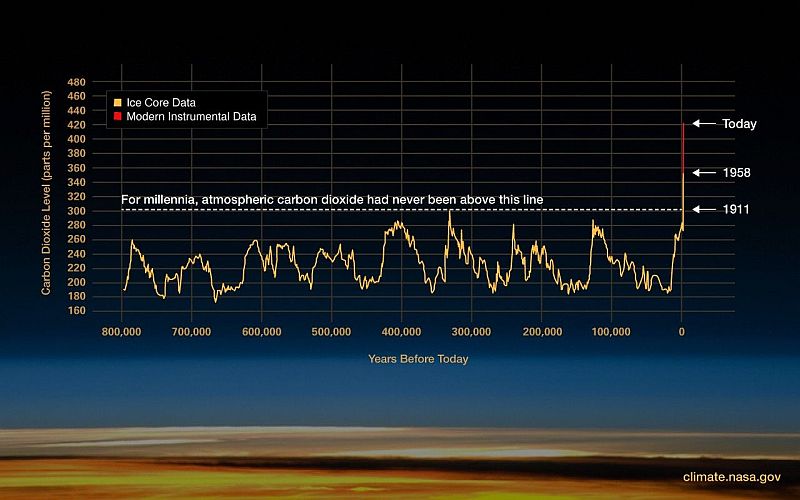
Fig. 1 This graph, based on the comparison of atmospheric samples contained in ice cores and more recent direct measurements, provides evidence that atmospheric CO2 has increased since the Industrial Revolution. Luthi, D., et al.. 2008; Etheridge, D.M., et al. 2010; Vostok ice core data/J.R. Petit et al.; NOAA Mauna Loa CO2 record. Source: (NASA 2022)
Irreversible Tipping Points: Approaching the Point of No Return
A critical question in climate science and policy today is whether we are approaching – or have already crossed – certain tipping points in the Earth’s climate system. Climate tipping points are thresholds beyond which a particular natural system shifts into a new, often irreversible state, potentially triggering self-perpetuating warming (Lindwall 2022). For example, continued deforestation and warming could push the Amazon rainforest past a tipping point, transforming it from lush forest into arid savannah – a change that would release vast carbon stores and further accelerate warming (Lindwall 2022). The fear is that beyond such thresholds, warming becomes effectively irreversible on human timescales and may even speed up due to positive feedback loops (Lindwall 2022). Scientists refer to this as reaching a “point of no return” for the climate (Lindwall 2022).
Recent research suggests we may be alarmingly close to these points. A 2022 study in Science concluded that with ~1.1 °C of warming already caused by humans, the world “may have already crossed some tipping point thresholds” and is likely to trigger more if warming exceeds 1.5 °C (Lindwall 2022). Earlier estimates assumed the danger zone for tipping points would start closer to 2 °C of warming, but improved models and observations have shifted that threshold downward (Lindwall 2022). Even the typically cautious Intergovernmental Panel on Climate Change (IPCC) warns that certain global tipping points could be triggered under emission trajectories that are very likely based on current trends (Lindwall 2022). In other words, if climate action fails and warming continues, the Earth could commit to irreversible changes such as collapsing ice sheets, permafrost thaw releasing methane, or dying forests – changes that would amplify warming in a dangerous feedback cycle (Lindwall 2022).
Determining whether a tipping point has been exceeded is challenging, because the actual “flip” into a new state might unfold over years or centuries even after the threshold is passed nrdc.org. However, the precautionary principle suggests we must strive to avoid even approaching these critical limits. Once a major tipping point is crossed, halting or reversing climate change becomes vastly more difficult – potentially impossible with any feasible human intervention (Lindwall 2022). For instance, if parts of the West Antarctic Ice Sheet have passed a tipping point of destabilization (as some observations hint (Lindwall 2022)), then even ending all greenhouse emissions might not save those ice sheets from eventually disintegrating, locking in meters of sea-level rise over coming centuries. In short, the evolution of global warming is non-linear: beyond a certain point, incremental emissions could set off cascading effects that propel the climate into a dramatically warmer state that humanity can no longer control (Lindwall 2022) (Carrington 2022).
The Imperative for Global Action – and the Failure to Act
If there is still a window of opportunity to prevent crossing these catastrophic tipping points, it lies in immediate and transformative global action to reduce greenhouse gas emissions. Climate scientists have repeatedly stressed that limiting warming to at most 1.5 °C (and certainly below 2 °C) is vital to avoid the worst impacts (Lindwall 2022). Achieving this requires rapid, large-scale shifts away from fossil fuels toward clean energy, preservation of carbon-storing ecosystems, and investment in adaptation. In essence, nothing less than a coordinated global effort – with all major nations and industries on board – can steer us onto a safer climate trajectory (Lindwall 2022).
Tragically, the prospects for such unified global action appear dim. Despite decades of warnings, international progress remains painfully sluggish and indecisive. Most countries have agreed in principle (through accords like the Paris Agreement) to cut emissions, but current pledges are nowhere near enough to meet the 1.5 °C goal (Maizland and Fong 2025). As of late 2022, policy analyses showed that even if nations implement their pledges, global temperatures would still likely rise well above 2 °C by 2100 – with ~2.7 °C of warming projected under current policies (Maizland and Fong 2025). In short, the world’s collective actions fall far short of its stated ambitions, reflecting a massive gap between rhetoric and reality.
Political and economic factors explain much of this inertia. Some leaders and influential figures still downplay or deny the climate threat, casting doubt on the need for urgent action (Maizland and Fong 2025). For example, a number of politicians – often influenced by fossil-fuel interests or ideological opposition – continue to dismiss climate science or prioritize short-term gains over long-term survival (Maizland and Fong 2025). This manufactured doubt and denial undermines public consensus and stalls policy. At the same time, even among those who acknowledge the problem, there is a collective-action dilemma: individual countries (or companies) fear the economic cost of cutting emissions unilaterally and becoming less competitive, so they hesitate unless others move in tandem. Economists describe this as a classic “free-riding” problem – voluntary climate agreements allow some actors to benefit from others’ reductions while doing little themselves, an approach “destined to fail” without stronger enforcement (Maizland and Fong 2025). Vested interests, including powerful fossil fuel corporations and industrial lobbies, have also pressured politicians to preserve the status quo, valuing immediate profits and growth over the global commons. The result is a paralysis of meaningful action: piecemeal measures, delayed commitments, and broken promises, even as the planet’s vital signs (melting ice, rising seas, extreme weather) flash red warnings.
It is vital to recognize that every year of indecision and insufficient effort pushes us closer to irreversible harm. The physics of climate change are unyielding – carbon emissions accumulate and persist for centuries, so failure to act now imposes a greater burden later. Yet, as climate scholar Bogdan Stojanović observes, the gradual, diffuse nature of the crisis dulls our sense of urgency: the progressive buildup of CO₂ has no immediate shock value, which “reduces the willingness of individuals and societies to take preventive measures” (Stojanovic 2025). This psychological and political inertia – the tendency to delay action until catastrophes become undeniable – may prove fatal. Unfortunately, if the world continues on its current path, the chances of avoiding a climate tipping point diminish to near zero, confirming the darkest prognoses for our warming future.
Consequences of Unchecked Warming: Conflict and Collapse
If humanity fails to avert catastrophic warming, the coming decades will bring increasingly severe and potentially irreversible impacts on natural and human systems. Global warming is not just an environmental issue; it is a civilizational security threat. By exacerbating resource scarcities, environmental stresses, and social inequalities, climate change can fuel instability and conflict. In fact, the IPCC and security analysts emphasize that climate change is a “threat multiplier” – it worsens existing problems (like poverty, hunger, political tensions) and heightens the risk of new crises (Stojanovic 2025).
One stark scenario is the prospect of wars over water and livable land. As temperatures rise, droughts intensify and glaciers retreat, fresh water supplies will diminish in many regions (Stojanovic 2025). Already-arid areas such as the Middle East and North Africa face extreme water stress, which could ignite competition over rivers and aquifers (Stojanovic 2025). The United Nations has warned that without better management, “water wars” could erupt in the future over shared rivers like the Nile or Euphrates (Stojanovic 2025). Global warming is increasing these vital stakes: shrinking food production, failing crops, and dwindling freshwater drive up desperation and can trigger violence. Meanwhile, heat and humidity could render large swaths of the tropics and subtropics physically uninhabitable for parts of the year, forcing mass migrations toward cooler climatestheguardian.com (Stojanovic 2025). In a world 3 °C or 4 °C warmer, regions near the equator might regularly exceed deadly heat thresholds, and billions of people could be on the move, seeking refuge in the currently temperate latitudes or polar regions. Such climate-driven migration would put immense strain on societies and could lead to border conflicts or even fights over the last habitable zones on Earth. Indeed, military strategists are already bracing for a future of geopolitical struggles fueled by climate stress, from the Arctic (now opening to resource exploration as it melts) (Stojanovic 2025) to low-lying islands disappearing under rising seas (Stojanovic 2025).
The breakdown of environmental stability has myriad negative effects on human survival. Scientists and policy experts paint a grim picture of the consequences if warming continues unabated, potentially exceeding any adaptive capacity. Some of the most critical anticipated impacts include:
- Water Scarcity and Famine: Drought and shifting climate zones will diminish crop yields and food supplies. Whole regions could face chronic hunger as farmlands turn to dust and fisheries collapse, leading to widespread famine (Carrington 2022). Freshwater shortages, as noted, may spark conflicts and humanitarian crises where populations can no longer be fed or sustained.
- Extreme Weather and Infrastructure Collapse: Stronger and more frequent extreme events (heatwaves, megastorms, wildfires) will batter human infrastructure and settlements. These disasters can come in clusters, e.g. a cyclone knocking out electrical grids followed by a lethal heatwave (Carrington 2022). Cities and economies could be repeatedly crippled, overwhelming our ability to recover.
- War and Civil Unrest: Competition over dwindling resources – food, water, arable land – and the strain of mass displacement will increase the risk of civil wars and international conflicts (Stojanovic 2025). Societies under extreme climate stress may descend into violence and authoritarianism, as states fight over territory or even resort to desperate measures like geoengineering without global consensus (Carrington 2022).
- Disease and Pandemics: A hotter world expands the range of tropical diseases and facilitates new pandemics. Habitat disruption can bring animal pathogens into closer contact with human populations. Weakened governments and refugee crises further amplify the spread of epidemics, as medical systems collapse and previously controlled diseases re-emerge.
In fact, an interdisciplinary group of scholars has warned of a potential “climate endgame” in which these factors feed on each other, leading to global societal collapse (Carrington 2022). They highlight four broad overlapping crises – nicknamed the “Four Horsemen” of climate change – that could push humanity to the brink (Carrington 2022):
- Famine: Large-scale crop failures and collapses in food production causing starvation and malnutrition.
- Extreme Weather: Intensified storms, heatwaves, floods, and wildfires that devastate communities and infrastructure.
- War: Heightened conflict ranging from local violence to wars between states over resources or mass migration.
- Disease: Outbreaks of infectious diseases (old and new) thriving in disrupted ecosystems and weakened societies.
Each of these “horsemen” is dangerous alone, but in combination they are catastrophic (Carrington 2022). For example, war can destroy the capacity to deliver food and healthcare, worsening famine and disease; extreme weather can trigger economic crashes that fuel conflict; and so on. This cascading effect means that beyond a certain warming, the risk is not just incremental hardship, but systemic collapse of modern civilization (Carrington 2022). In plain terms, if we push the climate far past its stable range, we may face a future where basic needs can’t be met, governance breaks down, and violence and chaos become endemic.
Societal Collapse Scenarios and the Question of Human Survival
How extreme could it get? If global warming passes an irreversible tipping point and surges onward, some scientists caution that civilizational collapse is not just possible but perhaps “dangerously underexplored” as a real risk (Carrington 2022). While mainstream projections often center on the 2–4 °C warming range by 2100, there is a non-zero chance of higher warming in the longer term, especially if feedback loops kick in (Carrington 2022). Warming beyond 4 or 5 °C would likely be devastating to the global economy and food supply; beyond 6 °C, it is hard to see how organized society as we know it could survive. At some point, uncontrolled warming could make large parts of the planet unlivable, raising the question of humanity’s very survival (Carrington 2022). Paleoclimate records show that the Earth hasn’t sustained temperatures 2–3 °C above preindustrial during the entire 10,000-year span of human civilization (Carrington 2022). Pushing far outside this “narrow climatic envelope” could overwhelm our species’ adaptive capacity. Indeed, climate change has been implicated in several past mass extinction events in Earth’s history (Carrington 2022) – a sobering reminder that runaway climate shifts can wipe out most life forms if they go far enough.
To envision what an extreme collapse scenario might look like, consider a phased trajectory of societal disintegration under escalating climate stress:
Phase 1 – Fragmentation and Survival of the Fittest: As climate disasters intensify, institutions begin failing in hard-hit regions. In this initial stage, the wealthy and powerful might withstand the longest – for example, some ultra-rich individuals are already preparing private bunkers and stockpiles to ride out an anticipated collapse (Rushkoff 2022). These “climate preppers” hope that personal fortresses or remote refuges (say, in New Zealand or the Alaskan wilderness) could keep them safe even if the rest of society crumbles (Rushkoff 2022). Similarly, nations with more resources may use authoritarian measures to secure food and water for their own populations, ignoring the suffering elsewhere. In this grim scramble, the most vulnerable – the poor, the weak, the marginalized – are the first to perish or be left behind. The “strongest” individuals or groups (by virtue of wealth, physical strength, or military might) attempt to survive independently, as collective systems falter.
Phase 2 – Technological Unraveling and Loss of Control: The next stage challenges even those initial survivors. Complex technology and infrastructure cannot be maintained by isolated enclaves indefinitely. Modern societies rely on vast, interdependent labor forces and supply chains; no billionaire’s bunker can have truly independent life support without a supporting civilization. This reality dawned on some tycoons who privately worry: “How do I maintain authority over my security force after the event?” (Rushkoff 2022). In a post-collapse world (“the event” being total environmental and social breakdown (Rushkoff 2022)), money loses meaning and hierarchies could be decided by force. Guards hired to protect a bunker might turn on their employers if law and order vanish. Equipment breaks down without skilled technicians and global supply networks to fix it. Food stocks eventually run out if farming collapses. In essence, the isolated fortresses of the rich and powerful would become unsustainable islands. Lacking a broad labor base and resource pipeline, even the best-prepared elites could not prop up industrial civilization alone. Bit by bit, the technologies that sheltered them (electricity, medicine, communications) would fail, and they too would be thrust into a more primitive struggle for basic survival.
Phase 3 – Ecosystem Collapse and the End of Human Habitat: In the worst-case scenario, climate change progresses to extremes that render the Earth hostile not just to civilization, but to human life itself. This would correspond to truly runaway warming – for instance, a scenario in which various feedback loops (melting permafrost releasing methane, dieback of forests releasing CO₂, loss of reflective ice causing more heat absorption, etc.) push global temperatures several degrees higher on their own. Some models even posit a theoretical tipping point where stratocumulus cloud decks could abruptly dissipate, causing an additional ~8 °C spike in temperature (Carrington 2022). If such a chain reaction occurred, the tropics might reach lethal heat/humidity combinations year-round, and mid-latitudes would face persistent mega-droughts and heatwaves incompatible with agriculture. Human physiology has limits – a wet-bulb temperature of about 35 °C can be fatal within hours – and large parts of the globe could surpass that threshold periodically, meaning humans could not survive outdoors (or eventually at all) in those regions. At extreme warming levels (e.g. >8–10 °C above preindustrial), the survival of any humans would be in jeopardy, even at the poles or high mountains, because the entire climate system might shift into a state far outside the range of our evolutionary adaptation. Water availability, food production, and breathable air (given rampant wildfires and possible breakdown of the oxygen-producing ocean cycle) would be gravely imperiled. While it is uncertain if all life forms would disappear – some extremophile microorganisms might persist – it is conceivable that unchecked warming could drive most complex life to extinction, including humanity. Scientists note that climate change has played a role in each of Earth’s past five mass extinctions (Carrington 2022). An Earth spiraling into a hothouse state could potentially initiate a sixth mass extinction that humanity, ironically the instigator, does not survive. In the absolute worst case, Earth might begin to resemble Venus: a “runaway greenhouse” where oceans evaporate and the surface becomes sterilized by extreme heat (Lea 2023). Such a Venusian outcome is deemed highly unlikely by most researchers under any near-term emission scenario, but it serves as a stark theoretical limit to remind us of the ultimate consequence of a greenhouse effect gone out of control – a planet devoid of life (Lea 2023).
Of course, these phases are speculative and not predetermined. They are doomsday scenarios of what could happen if humanity utterly fails to change course. The hope is that foresight and collective action will prevent such collapse. Yet, exploring these scenarios has value: it underlines that climate change is not just an incremental issue of lost GDP or more heatwaves – it is an existential threat in the truest sense (Carrington 2022). If we remain on our current trajectory, we flirt with the collapse of the very systems that support human life and society. It is a warning that bears repeating: the survival of civilization – and possibly our species – is at stake if global warming proceeds unabated.
Philosophical and Sociological Implications
The specter of global warming’s worst-case outcomes forces us to confront profound philosophical and sociological questions. One glaring issue is the moral failure of our political and economic systems to safeguard the future. Despite knowing the dangers, society has so far been unable to sacrifice short-term comforts and competitive advantages for the long-term common good. This reflects a tragedy of the commons on a planetary scale: individual nations and businesses act in their immediate self-interest (burning cheap fossil fuels, pursuing growth) even though collectively this leads to ruin. Politicians often think in election cycles and CEOs in quarterly earnings, while the climate crisis unfolds over decades – a mismatch that has led to denial, delay, and half-measures. Future generations, who have no say today, will bear the brunt of this negligence. The ethical question arises: Do we have the right to compromise the habitability of Earth for all who come after us? Most would say no, yet our actions (or inaction) move us toward that very outcome. Philosophically, climate change challenges humanity’s ability to act as wise stewards of our own destiny, testing whether reason, empathy, and foresight can triumph over greed, ignorance, and inertia.
Sociologically, the climate crisis also highlights issues of inequality and justice. Those least responsible (such as poorer nations and marginalized communities) are often the most vulnerable to climate impacts, while wealthy emitters may shield themselves longer. This disparity raises questions of fairness: how can the burdens of mitigation and adaptation be shared equitably? So far, global negotiations have struggled with this, as evidenced by debates over which countries should cut emissions first or pay for climate damages (Maizland and Fong 2025). If cooperation fails, one can envision a grim fragmentation – “climate apartheid” – where rich enclaves fortify themselves and let others suffer. But as the collapse scenarios illustrate, isolation is ultimately a delusion: no group can survive indefinitely alone. Our fates on a warming planet are intertwined, a reality that calls for an unprecedented level of global solidarity and governance.
The possibility of civilization’s collapse also forces a reflection on what matters in life. In a hypothetical near-extinction scenario, would our competitive drive for wealth and power seem tragically petty in hindsight? Quite possibly. Philosophers have mused that confronting existential risk could spur humanity to rethink its priorities – valuing sustainability, resilience, and community over endless consumption and conflict. It might even prompt a kind of spiritual reckoning: a recognition of our species’ vulnerability and the preciousness of the Earth’s biosphere. Some have drawn parallels to how nuclear war threats in the 20th century led to new international treaties and a realization that some global problems transcend politics. Climate change demands a similar awakening, a shift in consciousness to see ourselves not as isolated nations or corporations, but as a single human family sharing a finite, fragile home.
Finally, there is a sober question of legacy. If humanity were to fail and perish in a greenhouse cataclysm of its own making, what legacy would we leave? Perhaps only a thin layer in the geological record – a stark marker of the Anthropocene – testifying to a species that had the cleverness to alter an entire planet but not the wisdom to preserve itself. Contemplating this outcome is uncomfortable, but it may be necessary to jolt us into action. In the words of one climate analyst, “Facing a future of accelerating climate change while blind to worst-case scenarios is naive risk management at best and fatally foolish at worst.” (Carrington 2022) Recognizing the philosophical implications of climate change – our duty to future life, the meaning of progress, and the fragility of human enterprise – can inform and motivate the societal changes needed to avoid such a dark fate.
Conclusion
The evolution of global warming is at a crossroads. On one path, humanity manages to unite in an unprecedented effort to cut emissions, protect ecosystems, and innovate towards sustainability – in time to avert the worst outcomes. On the other, we continue with half-hearted measures and discord, thereby forfeiting our last chance to keep climate change within controllable bounds. The evidence presented here – from the clear reality of human-driven warming to the looming threat of tipping points and collapse – indicates that we are perilously close to the latter path. The tipping point for irreversible warming may soon be upon us, if it hasn’t already quietly been crossednrdc.orgnrdc.org. Yet the tipping point for collective action has not materialized; international cooperation remains fractured and inadequate, even as the clock ticks towards climate midnightcfr.org.
This study has outlined how, absent dramatic intervention, global warming could progress from a serious but manageable problem to an unstoppable, self-accelerating catastrophe. The consequences of such a trajectory – resource wars, societal breakdown, mass extinction – are almost too extreme to fathom, and certainly too dire to risk blithely. It serves as a warning that the cost of inaction is civilizational suicide. While the odds of achieving the required global mobilization may seem slim given today’s politics – “extremely small, almost zero,” as the pessimist might say – the alternative is to accept a future of chaos and collapse. As Alice C. Hill, a climate policy expert, bluntly put it: “We’re headed toward disaster if we can’t get our warming in check, and we need to do this very quickly.” (Maizland and Fong 2025)
In conclusion, the fight against catastrophic global warming is not just an environmental issue or a technological challenge; it is a test of humanity’s collective will and wisdom. Every fraction of a degree we prevent matters, and every action or policy that bends the curve of emissions could be the one that keeps us below the brink. Conversely, every delay brings us closer to a world governed by the ruthless forces of nature and survival. The philosophical stakes – our moral responsibility to life and future generations – demand that we not give in to despair or denial. Instead, we must heed the scientific warnings and treat this as a rallying cry for global solidarity. The window to act is still open, though narrowing. Whether the story of global warming will ultimately be one of enlightened turnaround or of tragic hubris remains up to us. Our choice, made in this present decade, will determine whether the trajectory of climate evolution leads to a sustainable new equilibrium – or an irreversible descent into a hothouse Earth where humanity’s story comes to an untimely end (Carrington 2022).
Sources
The analysis above is based on a synthesis of scientific reports and expert commentary on climate change, including findings from the IPCC, climate scientists, and security analysts. Key references supporting this study include: the U.S. EPA and IPCC statements on the human causes of warming (US EPA 2021); research on climate tipping points and irreversibility (Lindwall 2022); assessments of international climate policy gaps (Climate Action Tracker via CFR) (Maizland and Fong 2025); discussions of political and corporate inaction (CFR backgrounder) (Maizland and Fong 2025); analyses of climate change as a security threat leading to resource conflicts (Stojanovic 2025); projections of societal collapse and “climate endgame” scenarios (Carrington 2022); and speculative insights into how extreme warming could imperil human survival (Guardian and Space.com reports) (Carrington 2022) (Lea 2023). These sources, among others cited in the text, reinforce the urgent warning that without swift and unified action, global warming’s evolution may lead to outcomes that challenge the very continuation of life on Earth as we know it.
Bibliography
- Carrington, Damian. 2022. “Climate Endgame: Risk of Human Extinction ‘Dangerously Underexplored.’” Environment. The Guardian, August 1. https://www.theguardian.com/environment/2022/aug/01/climate-endgame-risk-human-extinction-scientists-global-heating-catastrophe.
- Lea, Robert. 2023. “How the Runaway Greenhouse Gas Effect Can Destroy a Planet’s Habitability — Including Earth’s.” Space, December 19. https://www.space.com/planets-earth-venus-greenhouse-gases-climate-change.
- Lindwall, Courtney. 2022. “Climate Tipping Points Are Closer Than Once Thought.” November 15. https://www.nrdc.org/stories/climate-tipping-points-are-closer-once-thought.
- Maizland, Lindsay, and Clara Fong. 2025. “Global Climate Agreements: Successes and Failures | Council on Foreign Relations.” https://www.cfr.org/backgrounder/paris-global-climate-change-agreements.
- NASA. 2022. Evidence – NASA Science. Climate Change. June 15. https://science.nasa.gov/climate-change/evidence/.
- Rushkoff, Douglas. 2022. “The Super-Rich ‘Preppers’ Planning to Save Themselves from the Apocalypse.” News. The Guardian, September 4. https://www.theguardian.com/news/2022/sep/04/super-rich-prepper-bunkers-apocalypse-survival-richest-rushkoff.
- Stojanovic, Bogdan. 2025. Negotiating the Climate: The Politics of a Changing Planet – Diplo. May 26. https://www.diplomacy.edu/blog/negotiating-the-climate-the-politics-of-a-changing-planet/.
- US EPA, OAR. 2021. “Causes of Climate Change.” Overviews and Factsheets. April 15. https://www.epa.gov/climatechange-science/causes-climate-change.
 Articol cu Acces Deschis (Open Access) distribuit în conformitate cu termenii licenței de atribuire Creative Commons CC BY SA 4.0 (https://creativecommons.org/licenses/by-sa/4.0/).




Leave a Reply