



Psih.Laura Mihaela TIHAN[1], M.Sc,; Psih. Eusebiu Jean TIHAN[2], M.Sc,
eusebiu.tihan@gmail.com
[1] Tihan & Associates, https://orcid.org/0009-0003-1820-1417
[2] Academia Oamenilor de Știință România, https://orcid.org/0009-0008-8316-3679
Abstract
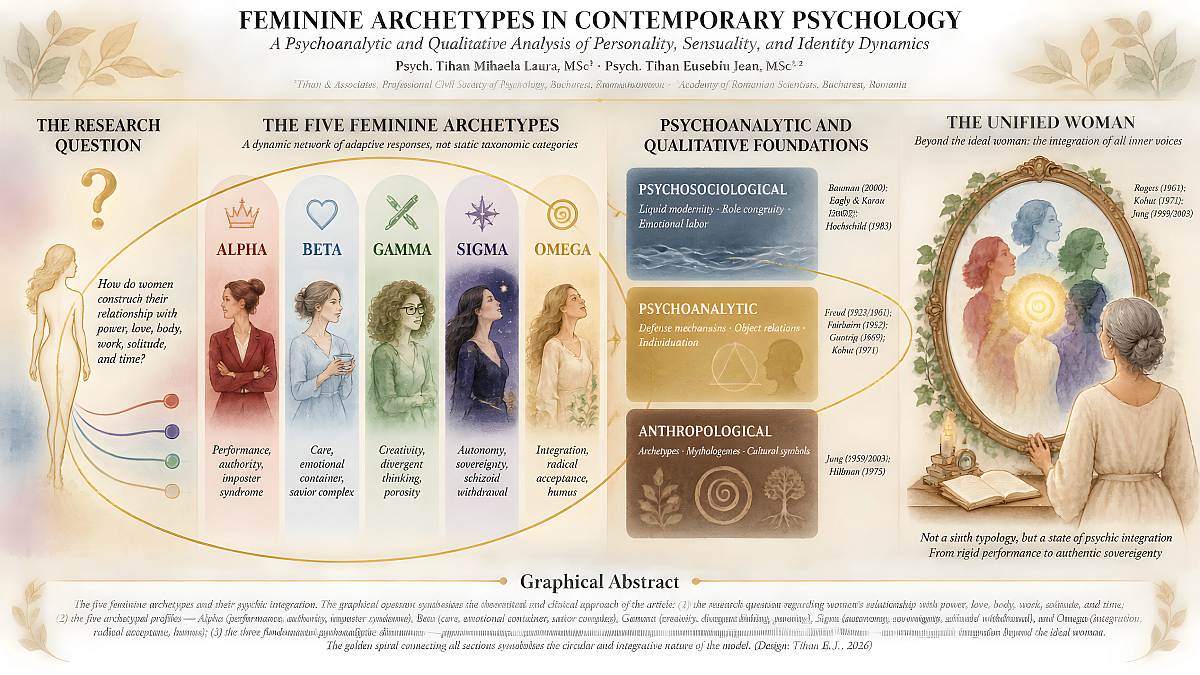
Objectives: This study aims to deconstruct and systematize the five feminine archetypal profiles — Alpha, Beta, Gamma, Sigma, and Omega — introduced in the analyzed unpublished manuscript. The central objective resides in mapping these personality structures onto established theoretical frameworks from psychoanalysis, psychosocial theory, and cultural anthropology, analyzing their adaptive foundations, defensive defense mechanisms, manifestations of sensuality, and identity dynamics in the face of postmodern societal pressures.
Methods: The research employs an eminently qualitative methodology based on data triangulation. The methodological pillars include: (1) in-depth textual content analysis based on the essays, (2) detailed semiotic visual analysis of the artistic visual representations (marked as design and author description), (3) anthropological and psychosocial analysis of cultural discourse, and (4) deconstructive analysis of composite clinical vignettes focused on performance-related patterns and codependency.
Results: The qualitative analysis demonstrates that the five profiles do not represent static taxonomic categories, but rather a dynamic network of adaptive responses. The Alpha profile may be read through the lens of compensatory narcissism — a heuristic analogy, not a clinical diagnosis; Beta may be interpreted through the lens of a dependent-type dynamic — a conceptual analogy, not a diagnostic category; Gamma may be understood through the concept of introjective porosity — an interpretive metaphor, not an empirically validated structure; Sigma may be read through the lens of schizoid dynamics — a heuristic analogy, not a clinical diagnosis; and Omega may be understood as an integrative dimension of the model— a psychic position in which the other archetypes are recognized, accepted, and held together, rather than transcended or surpassed.
Conclusions: Beyond commercial simplifications, the model of the five archetypes describes a circular and integrative model of the feminine Self. Their optimal integration allows for the transition from the pole of rigid performance to that of authentic sovereignty, offering a conceptual framework that may inform future psychotherapeutic research and practice.
Public Utility Statements: This article offers a conceptual and methodological reference framework that may be relevant to psychotherapy, couples counseling, and the study of personal identity processes. The study explores the hidden psychic costs of hyper-performance and self-sacrifice, contributing to reflection on intra-gender conflict and feminine cooperation.
Keywords: feminine archetypes, compensatory psychoanalysis, imposter syndrome, savior complex, psychic autonomy, Jungian individuation, semiotic analysis, psychological anthropology, identity dynamics.
Arhetipurile feminine în psihologia contemporană. O analiză psihanalitică și calitativă a personalității, senzualității și dinamicii identitare
Obiective: Acest studiu își propune să deconstruiască și să sistematizeze cele cinci profile arhetipale feminine — Alfa, Beta, Gama, Sigma și Omega — introduse în manuscrisul nepublicat analizat. Obiectivul central rezidă în maparea acestor structuri de personalitate pe teorii psihanalitice și psihosociologice validate, analizând fundamentele lor adaptative, mecanismele de apărare, manifestările senzualității și dinamica identitară în fața presiunilor societății postmoderne.
Metode: Cercetarea utilizează o metodologie eminamente calitativă bazată pe triangularea datelor. Pilonii metodologici includ: (1) analiza de conținut textual profund pe baza eseurilor, (2) analiza imagistică semiotică detaliată a reprezentărilor vizuale artistice (marcate ca design și descriere de autor), (3) analiza antropologică și psihosociologică a discursului cultural și (4) analiza deconstructivă a unor viniete clinice compozite, focusate pe patologia performanței și codependență.
Rezultate: Analiza calitativă demonstrează că cele cinci profile nu reprezintă categorii taxonomice statice, ci o rețea dinamică de răspunsuri adaptative. Profilul Alfa poate fi citit prin prisma narcisismului compensatoriu — o analogie euristică, nu un diagnostic clinic; Beta poate fi interpretată prin prisma unei dinamici de tip dependent — o analogie conceptuală, nu o categorie diagnostică; Gama poate fi înțeleasă prin conceptul de porozitate introiectivă — o metaforă interpretativă, nu o structură validată empiric; Sigma poate fi citită prin prisma dinamicii schizoide — o analogie euristică, nu un diagnostic clinic; iar Omega poate fi înțeleasă ca o dimensiune integrativă a modelului – o poziție psihică în care celelalte arhetipuri sunt recunoscute, acceptate și menținute împreună, mai degrabă decât transcendute sau depășite.
Concluzii: Dincolo de simplificările comerciale, modelul celor cinci arhetipuri descrie o spirală evolutivă a Sinelui feminin. Integrarea lor optimă permite trecerea de la polul performanței rigide la cel al suveranității autentice, oferind un model teoretic revizuit pentru practica psihoterapeutică contemporană.
Declarații de utilitate publică: Prezentul articol oferă un cadru de referință conceptual și metodologic aplicabil direct în psihoterapie, consilierea de cuplu și optimizarea personală. Studiul demască costurile psihice ascunse ale hiper-performanței și ale sacrificiului de sine, oferind strategii clinice clare pentru reducerea conflictului intra-genic și promovarea cooperării feminine.
Cuvinte cheie: arhetipuri feminine, psihanaliză compensatorie, sindromul impostorului, complexul salvatoarei, autonomie psihică, individuație jungiană, analiză semiotică, antropologie psihologică, dinamici ale identității.
CUNOAȘTEREA ȘTIINȚIFICĂ, Volumul 5, Numărul 4, Decembrie 2026, pp. xxx
ISSN 2821 – 8086, ISSN – L 2821 – 8086,
URL: https://www.cunoasterea.ro/en/feminine-archetypes-in-contemporary-psychology/
© 2026 Laura Mihaela TIHAN, Eusebiu Jean TIHAN. Responsabilitatea conținutului, interpretărilor și opiniilor exprimate revine exclusiv autorilor.
Licența CC BY 4.0
1. INTRODUCTION
The study of feminine personality within the psychological sciences has been marked, over time, by a continuous oscillation between reductionist biological determinism and radical social constructivism (Eagly & Wood, 1999). In an attempt to overcome these limitations, the present work proposes an innovative paradigm: the interpretation of personality typologies as dynamic, aesthetic, and existential manifestations of the feminine psyche.
Each of the five identified profiles — Alpha (The Queen), Beta (The Heart), Gamma (The Brain/Artist), Sigma (The Sovereign), and Omega (The Integrative Humus) — ceases to be a simple taxonomic label or a personal marketing tool. They become depth configurations, adaptive strategies, and complex defensive structures erected by the Ego in its attempt to navigate a hyper-demanding, often traumatizing sociocultural environment (Herman, 1992).
In the contemporary world, the pressure exerted on women is multidirectional and contradictory. Women are summoned to deliver economic performance and masculine-type authority (Alpha), to maintain the traditional role of emotional container and unconditional support (Beta), to be innovative and creative under conditions of precarity (Gamma), to project absolute and invulnerable independence (Sigma), and, at the same time, to manage the passage of time in a culture obsessed with eternal youth and cosmetic productivity (Omega). These dissonant requirements produce deep fissures in the structure of the Self (Horney, 1950).
The present article aims to deconstruct these archetypes by directly correlating the clinical and artistic intuitions of the authors with established theoretical frameworks from psychoanalysis, developmental psychology, social psychology, and cultural anthropology. The stake is not merely descriptive, but profoundly therapeutic and explanatory.
Declarations Regarding the Novelty of the Article
The present research brings a triple innovative contribution to the scientific landscape:
- Scientific Systematization of Clinical Essayism: It connects the psychoanalytic intuitions from the original text with established theories, such as the imposter syndrome model (Clance & Imes, 1978), object relations theories (Fairbairn, 1952; Guntrip, 1969), codependency dynamics (Norwood, 1985), and the individuation process (Jung, 1959/2003).
- Visual-Semiotic Approach: It integrates original visual design into academic analysis, demonstrating scientifically how aesthetic elements (chromatics, body posture, somatic indicators, and graphic symbols) are not simple illustrations, but direct codifications of internal psychodynamic realities (Barthes, 1977).
- Ecological, Non-Hierarchical, and Circular Perspective: Unlike popular taxonomies that place profiles on a rigid value scale, this study demonstrates that the model functions as an evolutionary spiral, in which Omega represents the psychic instance integrating all the other hypostases (Hillman, 1975).
2. METHODS
To capture the depth complexity of feminine archetypes and their narrative-explanatory nuances, an extended qualitative methodology was employed, based on the principle of data triangulation (Denzin, 1978). This approach allows overcoming the limitations of rigid quantitative research, which often fails to capture the fine defense mechanisms of the Ego and the subtle dynamics of subjective experiences (Braun & Clarke, 2006).
Qualitative Analysis: Methodological Pillars
In-depth Textual Content Analysis: Applied directly to the textual corpus of the manuscript. The units of analysis included clinical metaphors, idiomatic expressions, and semantic associations used by the authors (for example: “the crown that burns,” “imposter syndrome,” “savior complex,” “porosity between Self and world,” “the body as home,” “the humus that nourishes”). The text was coded along the axes: Id-Ego-Superego dynamics, attachment patterns, somatic and sensual manifestations, and emotional self-regulation strategies (Braun & Clarke, 2006).
Image Analysis (Extended Visual Semiotics): The five original visual representations were subjected to structural semiotic analysis, treated as authors descriptions of archetypal structures. The following were evaluated: facial micro-expressions, gaze vectors, camera angle (high-angle/low-angle perspective), body posture (crossed, open, supported arms), background elements (rigid urban architecture, pastoral nature, creative chaos, cosmic space, spiral landscape), and dominant-affective chromatic indicators (Barthes, 1977; Kress & van Leeuwen, 2006).
Anthropological and Psychosociological Discourse Analysis: The manner in which these archetypal labels are circulated, distorted, or internalized in contemporary mass media and on social platforms was investigated, identifying phenomena of cultural resistance or internalization of intra-gender misogyny (Goffman, 1959; Moscovici, 1961/2000).
Deconstructive Clinical Analysis (Composite Vignettes): Deconstructive Clinical Analysis (Composite Vignettes): Two composite clinical vignettes were constructed from recurring patterns observed in psychotherapeutic practice, illustrating how these archetypal constellations may manifest in symptomatology (performance anxiety, burnout, codependency, defensive isolation, melancholy) (Horowitz, 2004). These vignettes are illustrative and heuristic, not empirical case studies.
Ethical Considerations: This study did not involve human participants, interviews, psychological tests, or the processing of clinical records. The clinical vignettes included in the manuscript are composite and illustrative, constructed for heuristic purposes, not real individual clinical cases. All identifying details — names, professions, ages, geographic locations, and specific anamnestic elements — have been fictionalized and composited to protect confidentiality. The visual representations used are original conceptual artistic compositions and do not portray real patients. The research was guided by the ethical principles of the Declaration of Helsinki and the norms of the Romanian College of Psychologists.
3. PSYCHOLOGICAL, PSYCHOSOCIOLOGICAL, AND ANTHROPOLOGICAL FOUNDATIONS
To understand the emergence and persistence of the five feminine archetypes, it is imperative to place them at the intersection of three fundamental vectors: the psychosociological dynamics of postmodernity, the perspectives of cultural anthropology, and the depth structures of psychoanalysis.
3.1. Psychosociological Factors
Contemporary society, defined by Zygmunt Bauman as “liquid modernity” (Bauman, 2000), is characterized by the fragilization of interpersonal bonds, the fluidization of traditional institutions, and the imposition of an imperative of individual success governed by market logic. In this sociological paradigm, the solid social structures of early modernity — community, extended family, long-term career — dissolve into a continuous flux of temporary relationships, revocable commitments, and fluid identities.[3]
From a psychosociological perspective, the Alpha profile appears as a direct response to the internalization of capitalist values of efficiency, competition, and strategic management. Society rewards instrumental traits (assertiveness, dominance, goal focus), forcing the Alpha woman to adopt an armor of hyper-performance. The social cost, however, is isolation: she is often culturally sanctioned through penalizing labels (“shrew,” “arrogant”), because she violates the traditional gender prescription that associates femininity with gentleness (Eagly & Karau, 2002). This dynamic is rigorously explained by role congruity theory, which empirically demonstrates that the perceived incongruity between the feminine gender role and the leadership role produces two forms of prejudice: the perception of women as less suitable for leadership positions and the more severe evaluation of leadership behavior when exercised by a woman (Eagly & Karau, 2002).
At the opposite pole, the Beta archetype reflects the perpetuation of the “caregiver” role in a social system that consumes feminine emotional resources without economically or symbolically rewarding them (Hochschild, 1983). Beta functions as a social shock absorber. In a culture of exacerbated individualism, her loyalty and availability to hold “the umbrella over everyone” are often exploited, transforming her into the perfect victim of relational codependency dynamics (Norwood, 1985).
The Gamma, Sigma, and Omega archetypes represent different forms of resistance or adaptation to these vectors. Gamma flees from corporate standardization through creativity and the “gig” economy (marked by financial precarity and performance anxiety). Sigma chooses a path of radical autonomy, refusing to gravitate around traditional centers of power (man, corporation, extended family), transforming solitude into a currency of exchange for freedom (Guntrip, 1969). Omega, finally, sabotages the very capitalist imperative of continuous production: through the simple fact of being, she refuses validation through performance, becoming once again an external center of emotional recording (Rogers, 1961).
3.2. Aspects of Psychological Anthropology
From an anthropological perspective, these five profiles reactualize ancestral mythologemes and archetypal structures, reformulated to respond to the needs of the modern woman (Jung, 1959/2003; Hillman, 1975).
Alpha (The Queen / Goddess Athena): Embodies the archetype of the woman born from the father’s head, bearer of armor, oriented toward structure, strategy, and logos. She is the leader of the tribe, the one who masters public space and imposes law. Anthropologically, she sacrifices sacred vulnerability to ensure the survival and status of the group or her own person.
Beta (Goddess Demeter / Hestia at the micro level): Represents the nourishing principle, the archetype of the cosmic mother or devoted sister. She is the one who keeps the hearth fire burning, ensures the ritual cohesion of the tribe, and collects the community’s pains. In the absence of clear boundaries, she becomes the archetypal victim of self-sacrifice.
Gamma (The Muse / The Shaman / The Artist — The Persephone Hypothesis): Navigates between the real world and the subterranean world of the unconscious, of images and divergent ideas. She interprets signs, paints pain, sees the light at four o’clock, and deconstructs reality. She is the link between aesthetics and existentialism.
Sigma (The Lone She-Wolf / Goddess Artemis): Anthropology places her outside the citadel. Sigma is the autonomous huntress, the one who masters the wilderness and inner forests. She has a direct relationship with the sky and stars, without mediators. She does not ask the tribe’s permission to exist and defines her body as a sacred, impregnable territory.
Omega (The Great Mother / Gaia / The Earth-Woman): Represents the archetype of the wise old woman (Crone) or the primordial humus. She closes the circle of the existential alphabet. She no longer competes, no longer hunts, no longer serves blindly. She becomes the moist earth from which everything is born and to which everything returns — a pure ecological instance, centered on the conservation of life and the transformation of suffering into a vital resource (Jung, 1959/2003).
3.3. Depth Psychoanalytic Meanings
Methodological Note on the Status of Clinical Terminology
The psychoanalytic terms employed in this section — such as compensatory narcissism, dependent personality, constructive borderline porosity, schizoid dynamic, and cohesive self — are used here as heuristic analogies and interpretive lenses, not as clinical diagnoses or empirically validated structures. They are drawn from established psychoanalytic and psychodynamic frameworks (Freud, 1923/1961; Fairbairn, 1952; Guntrip, 1969; Kernberg, 1975; Kohut, 1971; Winnicott, 1965), but their application to the archetypal profiles analyzed in this article is conceptual and interpretive, not diagnostic.
The five archetypes (Alpha, Beta, Gamma, Sigma, Omega) are narrative constructs, not clinical categories. They were not derived from empirical research, not validated through psychometric instruments, and not tested on clinical populations. Any correspondence between these archetypes and clinical structures is therefore analogical, not ontological. The purpose of these psychoanalytic interpretations is to offer a depth-psychological reading of the narrative material, to make the archetypes more intelligible from a psychodynamic perspective, and to suggest possible directions for future empirical research.
Readers are explicitly cautioned against:
- using these terms to diagnose themselves or others;
- equating the archetypes with clinical disorders;
- assuming that the archetypes have been empirically validated as personality structures.
The clinical terminology used here should be understood as a conceptual vocabulary for reflection, not as a diagnostic manual. Any clinical application of these concepts requires rigorous assessment, appropriate professional training, and adherence to ethical and professional standards.
Psychoanalytic Interpretations of the Five Archetypes
At the psychodynamic level, the five archetypes can be decoded as specific structurings of the psychic apparatus (Id, Ego, Superego), determined by early attachment patterns and the resolution (or failure of resolution) of developmental conflicts (Freud, 1923/1961; Bowlby, 1969).
Within the interpretive framework of this model, the Alpha Woman may be read through the lens of compensatory narcissism — a heuristic analogy, not a clinical diagnosis. This reading is offered as a conceptual tool, not as an empirically validated structure. Behind the Grandiosity of the Ego (the perfectly tailored blazer, the untouchable authority) hides a fragile Self, gravely wounded in childhood through the lack of unconditional emotional validation. The child internalized the message that she is loved only if she performs. Her Superego is tyrannical, severely punishing any error and generating a continuous anxiety of not being “unmasked” (Clance & Imes, 1978). The principal defense mechanism is reaction formation (I behave as if I were invincible to hide the fact that I feel powerless). This clinical configuration is congruent with the dimensional model of pathological narcissism, which recognizes both grandiose and vulnerable aspects, both manifest and covert presentations (Pincus & Lukowitsky, 2010).
The Beta Woman may be interpreted through the lens of a dependent-type dynamic — a conceptual analogy, not a diagnostic category. The boundaries of her Ego are extremely weak, her identity being parasitized by the other’s needs. Her attachment is of the insecure-ambivalent or anxious type (Ainsworth et al., 1978). To avoid abandonment anxiety, she uses as defense mechanisms projection (she projects her own unsatisfied needs onto the partner) and sublimation through compulsive caregiving (the savior complex) (Norwood, 1985). Her Ego draws its sap exclusively from external validation: “I exist only if I am useful, I exist only if I am loved” (Horney, 1950).
The Gamma Woman may be understood through the concept of introjective porosity — an interpretive metaphor, not an empirically validated structure. This porosity between Self and world evokes a constructive borderline-type functioning (at the personality level, not psychotic). The boundaries between the primary unconscious (images, archetypes, creative pulsions) and consciousness are extremely thin (Kernberg, 1975). Gamma uses intellectualization and fantasy escape to manage an environment she feels sharp, traumatizing, and noisy. Her rigid Superego punishes her for nonconformism, generating a deep fear of being “abnormal” (Winnicott, 1965).
The Sigma Woman may be read through the lens of schizoid dynamics — a heuristic analogy, not a clinical diagnosis (approached from a relational perspective, according to Fairbairn, 1952 and Guntrip, 1969). To protect an extremely sensitive interior traumatized by early intrusions, Sigma withdraws libido from external objects and invests it in her own Ego. Her principal mechanism is defensive withdrawal (“the world is too noisy, I remain in my garden”). She develops the fantasy of absolute self-sufficiency: “I need no one, I am enough for myself,” transforming independence into a rigid barrier against authentic intimacy (Guntrip, 1969).
The Omega Woman may be interpreted as an integrative dimension of the model — a conceptual analogy, not as a clinical endpoint or a superior stage. This reading draws on Kohut’s concept of the Cohesive Self and Jung’s process of individuation (Kohut, 1971; Jung, 1959/2003). At Omega, the tyrannical Superego has been tamed and integrated. She no longer uses primitive defense mechanisms, but resorts to radical acceptance and transcendence. She allows the Ego to relax, recognizing that “the universe does not need to be led.” The conflict between instances is dissolved: the Id (warm sensuality, organic desires) coexists in peace with the conscious Ego and with a Superego transformed into a gentle ethical guide (Kohut, 1971).
To provide a synthetic visual representation of the proposed theoretical model, we have elaborated a conceptual diagram illustrating the circular and non-hierarchical structure of the five feminine archetypes (see Figure 1).
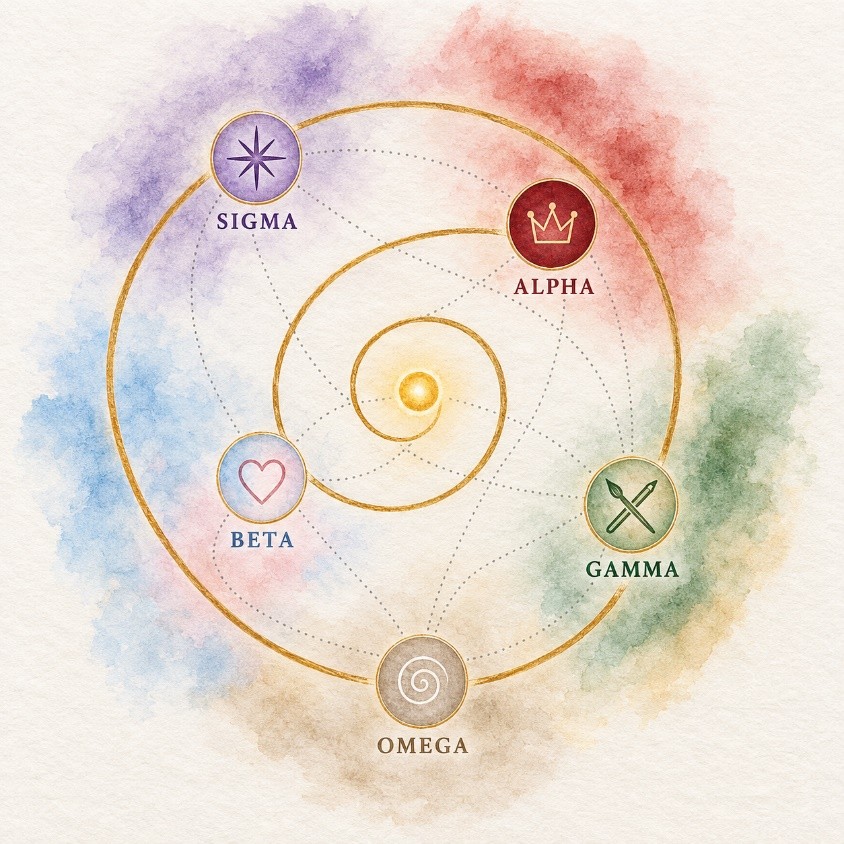
Figure 1. The spiral of the five feminine archetypes. The diagram illustrates the non-hierarchical and circular structure of the proposed model: Alpha (crown — power, performance), Beta (heart — care, emotional container), Gamma (brush/pencil — creativity, divergent thinking), Sigma (eight-rayed star — autonomy, sovereignty), Omega (spiral — integration, transcendence). The spiral arrows suggest evolutionary movement, not a value hierarchy. Each archetype is connected to the others through a fine network of lines, indicating their permeability and coexistence within the same Self. (Conceptual design: Tihan EJ., 2026)
As observed in Figure 1, the five archetypes are not arranged in a rigid hierarchy, but in an evolutionary spiral, in which each node is connected to the others through a network of dynamic relationships. This visual structure supports the central argument of the article: archetypes are not static categories, but fluid positions in the psychic economy of the feminine Self.
4. DEVELOPMENT OF THE TEXTUAL AND IMAGISTIC ANALYSIS SECTION
In this section we will proceed to a micro-structural deconstruction of each archetype, operating a direct triangulation between the elements of the analyzed manifest text and the semiotic indicators of the images conceptualized by the author (Kress & van Leeuwen, 2006).
4.1. The ALPHA Woman — The Queen Who Learned to Lead
In-depth Textual Analysis
The text introduces Alpha through a series of negations and assertions of a cutting force: “perfectly tailored blazer, straight shoulders, red lipstick that doesn’t transfer onto the glass, a gaze that cuts through glass and indecisive men.” From a stylistic point of view, an accumulation of attributes of external invulnerability is used to construct what in psychoanalysis we call the Persona (the social mask) (Jung, 1959/2003). The expression “it seems power was poured into her bones” suggests an almost biological determinism of force, but the text immediately operates a radical clinical reversal: “The Alpha Woman was not born Alpha. She became one.”
The traumatic chronology of her becoming is marked by milestones of forced adaptation:
- At 12: “if she doesn’t raise her hand first in class, the teacher looks right through her” (Trauma of invisibility).
- At 16: “if she smiles too much, she is considered stupid, and if she doesn’t smile at all, she is considered a shrew” (Social double bind) (Bateson et al., 1956).
- At 20: “to wear heels even if they hurt her soles to tears and never cry in meetings, even if inside she screams” (Somatization of pain and repression of affect) (Freud, 1923/1961).
The analysis of the textual discourse reveals the economic and social costs of this mask: Alpha eats “a healthy bowl in front of the laptop,” isolated from colleagues. In the intimate sphere, her efficiency becomes a “form of brutality.” The major change occurs in the post-orgasm moment, described as a breach in the armor: “she needs five minutes in which to be small… to be held without being asked for anything in return.” Here the text touches the regressive nucleus of the wounded Self, which yearns for an unconditional parental embrace (Winnicott, 1965).
Semiotic Imagistic Analysis
The image of the Alpha Woman is a masterpiece of the projection of rigid authority.
Gaze Vectors and Camera Angle: The angle is slightly from below upward (discreet low-angle), a technical artifice meant to enhance the sensation of dominance, power, and imperial stature. The woman’s gaze is fixed, direct, oriented toward the spectator, nuanced by a subtle asymmetry of the eyebrows that betrays critical evaluation and skepticism.
Body Posture: The arms are tightly crossed at the chest. In non-verbal and semiotic language, this functions as a double barrier: on the one hand, it protects the solar plexus (the zone of emotional vulnerability) from external intrusions; on the other hand, it is a posture of self-containment, of gathering one’s inner ranks. The fingers with long nails, painted in dark red, are strategically placed over the arms, suggesting fine administrative control (Kress & van Leeuwen, 2006).
Chromatic and Vestimentary Indicators: The chromatic dominant is given by the blazer made of a heavy material, velvet or suede, of a burgundy/dark wine color (the color of coagulated blood or the royal mantle). This shade transmits power, but also a feeling of restraint and sobriety. The bright red lipstick on the lips contrasts strongly with the white of the inner top, becoming a focal point that draws attention to the logos — the mouth that issues commands, that does not simulate, and that speaks clearly.
Background Elements: Behind the character one observes an immense window through which is profiled an urban landscape dominated by rigid skyscrapers, bathed in the light of an incandescent sunset (tones of orange and burnt yellow). The urban background codifies “the citadel,” the corporate space of wild competition, while the sunset suggests “the crown that burns” — the cyclical exhaustion of the queen who must govern over an empire of glass. On the desk, in the right corner, one distinguishes elegant writing instruments and a dried red rose in a glass vase, a visual metaphor of sensuality sacrificed on the altar of rigorous management.
The semiotic analysis of the Alpha portrait reveals a complex visual structure, in which chromatic, postural, and background elements codify the fundamental tension between power and vulnerability (see Figure 2).

Figure 2. The Alpha Woman — the anatomy of power and secret vulnerability. Watercolor portrait. The illustration captures the fundamental duality of the Alpha typology: the strong, composed exterior, with a dark red blazer and direct gaze, and the fragile interior, suggested by the diffuse watercolor washes in the background. Red dominates the chromatic palette, symbolizing both repressed passion and the energetic price of power. The corner flowers, discreet and pale, suggest the secret vulnerability that Alpha shows only to the one who “doesn’t run when he sees her without the crown.” (Design: Tihan EJ., 2026)
As observed in Figure 2, the Alpha portrait is not a simple illustration, but a visual codification of psychic duality: the dark red blazer and crossed arms signal authority and self-containment, while the diffuse watercolor washes and the wilted flower in the background suggest the secret vulnerability that Alpha protects with such rigor.
4.2. The BETA Woman — The Heart That Holds the World Together
In-depth Textual Analysis
The Beta profile opens under the sign of absolute availability: “There is a woman you call first when you have good or bad news. She always answers. At two in the morning, with a sleepy voice, but with a heart awake on the spot.” The narrative structures used are warm and hyperbolic, to underline the emotional container function of this archetype. Beta is described as an invisible anti-entropy force: “Without her, everything would dissipate into silences, into forgettings, and into unwashed dishes.”
The text operates a severe critique of consumer personal development manuals that label Beta as lacking personality. The authors redefine this dynamic as radical loyalty: “She is not dependent, she is loyal in a world that has made leaving a virtue.” However, the text relentlessly diagnoses her behavioral trap: “Beta suffers from the savior complex… She remains too long in a relationship that wounds her… He, in the end, looks at her with a mixture of guilt and boredom and says the words that hurt most: ‘You are too good for me'” (Norwood, 1985). The logic behind this dynamic is the perverse transposition of rejection: the partner flees from an Ego-mother to seek an Ego-limit (Alpha).
Semiotic Imagistic Analysis
The image of the Beta Woman contrasts strikingly with the geometric rigidity of the Alpha profile.
Gaze Vectors and Camera Angle: The angle is neutral, at eye level, inducing an immediate sensation of equality, emotional proximity, and familiarity. The woman’s gaze is not oriented directly toward the camera, but is directed upward and to the right, lost in a warm, gentle reverie, reflecting a projection of hope and inner goodness.
Body Posture: The posture is completely open, relaxed. The woman is seated at a rustic wooden table, holding with both hands a porcelain teacup with fine floral motifs. The hands that cup the teacup act as a symbol of containment: she offers warmth, but at the same time gathers her own resources so as not to scatter. The shoulders are lowered, and on her face one reads a discreet smile, marked by the presence of delicious freckles that anthropologize the image, sending to the idea of naturalness and purity.
Chromatic and Vestimentary Indicators: She wears a vaporous dress of a lacy material in baby blue, sprinkled with small white floral motifs. From a psychological point of view, light blue symbolizes peace, tranquility, spirituality, and devotion, but also a certain vulnerability in the face of life’s cold currents. At her neck she wears a discreet chain with a small heart-shaped pendant, a semiotic indicator directly of her existential center.
Background Elements: The background of the image is a corner of a garden flooded with warm summer light. Behind her are profiled rich bushes of pink roses and lavender flowers, an old wooden fence, and a bucolic atmosphere. In the lower left corner, on the table, there is a vase with daisies and an old book, bound in cloth — symbols of attachment to the past and of classical values. The garden is the external projection of her soul: a space cultivated with care, but exposed to the elements if clear limits are not drawn (Kress & van Leeuwen, 2006).
The semiotic portrait of the Beta woman contrasts strikingly with the geometric rigidity of the Alpha profile, proposing an aesthetic of gentleness, warmth, and availability (see Figure 3).

Figure 3. The Beta Woman — the heart that holds the world together. Watercolor portrait. Beta is rendered in a pastel palette of washed-out blue and dusty pink, colors of gentleness and availability. The dress with lace collar and floral embroidery suggests the romantic, warm, non-seductive aesthetic. The warm smile, but with traces of tiredness in the gaze, reflects “the smile that doesn’t flinch” — the mask that Beta wears to hide her exhaustion. The floral background, rich and diffuse, suggests the quality of “invisible binder” of the Beta woman. (Design: Tihan EJ., 2026)
As observed in Figure 3, the visual elements — pastel colors, open posture, the teacup held with both hands, the rich floral background — construct a portrait of the Beta woman as the “invisible binder” of the world, but also as a potential victim of her own availability. The warm smile, but with traces of tiredness in the gaze, codifies the tension between giving and exhaustion.
4.3. The GAMMA Woman — The Brain with an Artist’s Soul
In-depth Textual Analysis
The text places Gamma within a sphere of altered, superior perception: “While Alpha speaks loudly and convincingly at the meeting, Gamma observes how the light at four in the afternoon falls on the glass of water and wonders how she could paint that.” From a stylistic point of view, the technique of simultaneous contrast is used to highlight divergent intelligence. Gamma does not live in the logic of immediate action, but in that of aesthetic and conceptual processing: “today’s pain has the color of navy blue, with edges of dirty yellow.”
A profound psychodynamic dimension has been identified in the text: Gamma suffers from performance anxiety and from the alienating fear of being “abnormal” in a standardized world. Financial instability (“the following month she doesn’t know how she will pay her rent”) is her structural shadow, determining a continuous psychic wear. The text excels in describing her sapiosexual-type sensuality: a partner may be attractive, but if he emits clichés, Gamma mentally escapes toward processes in nature. She needs her mind to be penetrated by a revolutionary idea before her body can vibrate.
Semiotic Imagistic Analysis
The image of the Gamma Woman is a dense agglomeration of graphic signs and cultural symbols.
Gaze Vectors and Camera Angle: The character is caught in a posture of profound introspection. The gaze is directed upward and to the left, the large, luminous eyes being placed behind round, thin-framed glasses. The glasses function as a double screen: they amplify inner vision, but also signal an intellectual barrier placed between the Self and the assault of raw reality.
Body Posture: The woman supports her chin on her right hand, in a feminine reissue of the classic meditator’s posture. In the fingers of her left hand, raised negligently, she holds a thin brush, and her long, curly hair is tied in a disordered bun, fixed with the help of a writing instrument. This posture denotes total abandonment in the act of creation, the deliberate neglect of rigid commercial aesthetic arrangement canons, and the concentration of energy in the upper floor, that of ideas.
Chromatic and Vestimentary Indicators: She wears a shirt or robe of Bohemian inspiration, made of a fluid material with ethnic motifs textured in shades of olive green, mustard yellow, and earthy accents. The color green dominates the composition of the garment, sending to the idea of organic growth, germination of ideas, but also to the instability of oscillating soul states. At her neck she wears a large, round medallion, which encapsulates a natural element, underlining her connection with the micro-universe.
Background Elements: The background of the image is an artist’s studio flooded with an archetypal ordered chaos. Shelves packed with old books, botanical sketches spread on the table, an intensely used watercolor palette, a coffee cup with vegetal motifs, and a tabby cat sleeping deeply on a stack of books. On the spines of the books in the lower left, one can read conceptual titles: “Art”, “Ideas”, “Travels”, “A Brighter Me”. Light enters through a large window, invaded by climbing plants, opening the studio space toward a distant historical perspective (the dome of an old building), suggesting her connection with the atemporal.
The semiotic portrait of the Gamma woman is a dense agglomeration of graphic signs and cultural symbols, which configure an inner universe based on curiosity, nonconformism, and divergent thinking (see Figure 4).

Figure 4. The Gamma Woman — the brain with an artist’s soul. Watercolor portrait. Gamma is framed by elements that define her inner universe: books, brushes, color palettes, ink, and unfinished sketches. The round glasses and curly hair, loosely tied, suggest nonconformism and intellectual curiosity. The emerald green and ochre palette evokes the organic world of ideas, mushrooms, and rain — recurring themes in the text. The slightly lateral, absent gaze is characteristic of the Gamma woman: physically present, but with the mind already in the future, in an idea. (Design: Tihan EJ., 2026)
As observed in Figure 4, the visual elements — round glasses, curly hair loosely tied, color palette, books, and unfinished sketches — construct a portrait of the Gamma woman as a “brain with an artist’s soul.” The slightly lateral, absent gaze codifies physical presence in the real world and, simultaneously, the migration of the mind into a universe of ideas, images, and unusual associations.
4.4. The SIGMA Woman — The Sovereign Who No Longer Revolves Around Anyone
In-depth Textual Analysis
The text defines Sigma through the operation of a radical cosmological rupture from the first two typologies: “If Beta revolves around the man-sun and Alpha wants to be the sun herself… the Sigma woman understood… that she is neither planet nor sun. She is the universe itself.” An expansionist, cosmic semantics is used to describe the liberation of the Sigma Ego from dependence on social networks or masculine validation. Her body undergoes a process of metaphorical transmutation: “her hair… is the Milky Way poured over her shoulders… her belly… is the big bang.”
The clinical profile of Sigma nevertheless highlights the trap of flight from intimacy: “Sigma confuses independence with isolation. Independence says: ‘I need time alone to recharge.’ Isolation says: ‘I need no one ever.'” In bed, Sigma completely sabotages traditional scenarios: she does not simulate, does not play archetypal roles of helplessness, and if she does not feel connection, she simply stops, without apologizing. The fundamental expression identified in the content analysis is: “my body is not an argument, it is a home.” This represents a revolutionary redefinition of somatization, the body ceasing to be an object of external gaze in order to become a space of sovereign inhabitation.
Semiotic Imagistic Analysis
The image of the Sigma Woman totally abandons earthly and domestic landmarks, projecting the character into a mythic-cosmic frame.
Gaze Vectors and Camera Angle: The person is caught in a three-quarter profile, with her head turned proudly to the right, looking beyond the limits of the frame. The gaze is fixed on a distant spiral galaxy, her eye reflecting the light of the stars. The camera angle underlines the line of the neck, suggesting a posture of sovereignty. Her features express neither fury (as with Alpha) nor a smile (as with Beta), but a serene detachment.
Body Posture: One hand is placed firmly on the hip (posture of anchoring in her own power and delimitation of personal territory), while the other hand is left to fall fluidly along the body. This combination of firmness and fluidity shows that Sigma is not rigid like Alpha, but perfectly controls her energy. Her deep black hair is tied in a loose hairstyle from which rebellious strands escape, seeming to blend with the nebulae in the background.
Chromatic and Vestimentary Indicators: She wears an evening dress of absolute elegance, made of silk or transparent voile in black, with a generous V-neckline that does not vulcanize the image, but transforms it into a manifesto of self-possession. The black of the dress functions as a protective screen: it absorbs betrayals and pains without letting them fragment her nucleus. At her neck she wears a single element of adornment: a pendant in the shape of an eight-rayed star, symbol of the inner compass and of self-guidance.
Background Elements: The background is a spectacular representation of deep cosmic space. Nebulae in shades of violet, purple, and indigo, bright stars sparkling intensely, and a huge spiral galaxy rotating in the upper right corner. Distant planets float in this fertile void. The background codifies the textual message: Sigma is her own universe, a psychic structure that has integrated the infinite and no longer depends on the micro-dramas of the citadel to justify her existence.
The semiotic portrait of the Sigma woman totally abandons earthly and domestic landmarks, projecting the character into a mythic-cosmic frame (see Figure 5).

Figure 5. The Sigma Woman — the sovereign who no longer revolves around anyone. Watercolor portrait. Sigma is rendered in a cosmic background, with stars and nebulae, suggesting her personal cosmology: “she is neither planet nor sun, but the universe itself.” The black dress, sober, without ornaments, and the hair tied in a loose bun, express autonomy and sovereign detachment. The gaze is directed toward a distant point, beyond the frame — a sign of the fact that Sigma does not define herself in relation to others, but in relation to her own inner world. (Design: Tihan EJ., 2026)
As observed in Figure 5, the visual elements — cosmic background, sober black dress, gaze directed beyond the frame, star-shaped pendant — construct a portrait of the Sigma woman as sovereign of her own inner world. Unlike Alpha, who dominates through force, Sigma dominates through self-possession; she no longer gravitates around any external center.
4.5. The OMEGA Woman — The One Who Has Returned Home
In-depth Textual Analysis
Omega represents the terminal point and at the same time the origin of the model: “If Alpha is the beginning of the alphabet of power, Omega is the end of illusion. The Omega Woman is not the last, but the one who has closed the circle.” The textual analysis reveals the use of an organic, ecological, and spiritual semantics: “the humus that nourishes the world,” “the whisper of the earth,” “offering instead of sacrifice.” The popular myth of the Omega woman as a figure of biological resignation is deconstructed, showing that she can have any biological age, because her maturity is one of “peeled layers of truth.”
Her process of becoming necessarily involves a major existential crisis (divorce, burnout, grief) that acts as a smelter of the previous masks. Omega operates an organic withdrawal in which “she asks forgiveness from her body… and from the little girl she was.” From a psychoanalytic point of view, a unique resolution of the narcissistic dynamic has been identified: Omega no longer produces, she is, which in a utilitarian world represents a revolutionary act. Her shadow is consciously assumed as a “sweet melancholy,” a transpersonal sadness that vibrates with the pain of the world, becoming a factor of collective healing through the containment that stops intra-gender conflicts.
Semiotic Imagistic Analysis
The image of the Omega Woman is an epiphany of full integration and psychic peace.
Gaze Vectors and Camera Angle: The character is depicted frontally (complete frontality), indicating total transparency, the absence of any mask or intention of dissimulation. The gaze is directed directly toward the viewer, full of an infinite, warm, and forgiving gentleness. The camera angle is neutral, perfectly at the level of the heart, eliminating any hierarchical distance.
Body Posture: The woman is caught in movement, walking slowly through the middle of a wild field of flowers. Her arms are wide open laterally, with palms turned upward and outward, in an archetypal gesture of blessing, unconditional reception, and cosmic offering. Her posture says: “I have nothing more to hide, I have nothing more to defend, I receive everything and I offer everything.” Her feet are completely bare, touching the moist earth directly, codifying a profound clinical grounding (earthing) and the direct refusal of the somatic tension from the Alpha profile.
Chromatic and Vestimentary Indicators: She wears a long, fluid dress, of a cream white or warm ivory, made of a natural material. The dress is discreetly decorated on the chest and hem with embroideries reproducing the Greek letter Omega (Ω). Her hair is long, rich, completely gray/silver, flowing freely in the wind. In semiotics, silver hair is no longer an indicator of decline, but of transmuted wisdom, of the precious metal obtained following the burning of illusions. On her face one reads a joy without reason.
Background Elements: The background is a hilly landscape of classic beauty, bathed in the golden light of a sunrise. The woman walks through a rich field of white daisies and violet lavender bushes (violet being the color of transcendence). On the left rises a secular olive tree, symbol of peace and resistance in time. In the distance, one glimpses a water shimmer and an old stone house, signifying the final destination: “returning home” to the matrix of the authentic Self.
The semiotic portrait of the Omega woman is an epiphany of full integration and psychic peace, in which natural elements and archetypal gestures codify the state of “joy without reason” (see Figure 6).

Figure 6. The Omega Woman — the one who has returned home. Watercolor portrait. Omega is rendered barefoot, in a simple white linen dress, in a landscape of fields and wildflowers. The Omega symbols (Ω) discreetly embroidered on the dress suggest the fulfillment of the cycle. The gray hair, tied in a loose ponytail, and the expression of deep peace, without makeup, express the state of “joy without reason” and reconciliation with oneself. The natural background, with field plants and gentle hills, suggests the cosmology of humus: Omega no longer wants to be sun, moon, or galaxy, but the nourishing layer from which everything grows. (Design: Tihan EJ., 2026)
As observed in Figure 6, the visual elements — barefootedness, white linen dress, arms open in a gesture of offering, gray hair flowing freely, Omega symbols embroidered on the dress — construct a portrait of the Omega woman as “humus” from which everything grows. Unlike Sigma, who is the universe itself, Omega has taken the next step: she has understood that the universe does not need to be led, but nourished.
4.6. The Unified Woman — The Psychological Mirror: The Five Inner Instances and the Unified Woman
To synthesize the analytical approach of the entire article — the passage from narrative typologies to deep psychic structures — we have elaborated a conceptual illustration that configures the five inner instances as layers of the same Self (see Figure 7).

Figure 7. The psychological mirror: the five inner instances and the Unified Woman. Original illustration for Part II. The image synthesizes the analytical approach of the article: the passage from narrative typologies to deep psychic structures. The five silhouettes reflected in the oval mirror are not separate characters, but layers of the same Self, and the woman in front of the mirror is the witness who recognizes, accepts, and integrates them. The discrete symbolic elements — the pocket watch without hands, the open book with blank pages, the ivy thread on the frame — suggest that psychic time is not linear, that the story continues to be written, and that life persists and adapts. (Design: Tihan EJ., 2026)
As observed in Figure 7, the five silhouettes reflected in the oval mirror are not separate characters, but overlapping layers of the same Self, and the woman in front of the mirror is the witness who recognizes, accepts, and integrates them. The discrete symbolic elements — the pocket watch without hands, the open book with blank pages, the ivy thread on the frame — suggest that psychic time is not linear, that the story continues to be written, and that life persists and adapts.
5. ILLUSTRATIVE CLINICAL VIGNETTES
Before presenting the two clinical vignettes that illustrate the practical applicability of the archetypal model, a preliminary methodological clarification is required. The status of these vignettes is not that of empirical case studies, but of composite conceptual illustrations, constructed from recurring patterns observed in psychotherapeutic practice. For this reason, the present section opens with a methodological note intended to specify the nature, purpose, and limits of the illustrative material that follows. The reader is invited to read this note before engaging with the vignettes themselves, in order to correctly understand their epistemological status.
Methodological Note on the Status of the Illustrative Vignettes
The two clinical vignettes presented in this section (Sections 5.1 and 5.2) are composite conceptual illustrations, not real case studies. They were constructed by synthesizing recurrent patterns observed in psychotherapeutic practice, with the explicit purpose of illustrating how the archetypal model may manifest in clinical contexts. They do not represent individual patients, and any resemblance to real persons is purely coincidental.
These vignettes were not selected from a sample, not subjected to statistical analysis, and not part of a longitudinal study. They are not intended as empirical evidence for the validity of the archetypal model, nor as diagnostic tools. Their function is heuristic and illustrative: they serve to make the abstract theoretical constructs more concrete and accessible to the reader, and to suggest possible directions for future empirical research.
All identifying details — names, professions, ages, geographic locations, and specific anamnestic elements — have been fictionalized and composited to protect confidentiality and to avoid any possibility of identification. The psychodynamic nucleus of each vignette is based on patterns that are well-documented in the clinical literature, but the specific narrative details are constructed for illustrative purposes.
Readers are therefore invited to approach these vignettes as conceptual tools for reflection, not as clinical evidence. Any clinical application of the model should be based on rigorous assessment, appropriate training, and adherence to ethical and professional standards.
Transition to the Illustrative Vignettes
Having clarified the methodological status of the illustrative vignettes, we now present two composite clinical vignettes that exemplify how the Alpha and Beta archetypal constellations may manifest in psychotherapeutic practice. These vignettes are not empirical case studies, but conceptual illustrations constructed from recurring patterns observed in clinical work. Their purpose is heuristic: to render the abstract theoretical constructs more concrete and accessible, and to suggest possible directions for future empirical research. As stated in the methodological note above, any resemblance to real persons is purely coincidental, and the clinical material has been fictionalized and composited to protect confidentiality.
Illustrative Clinical Vignettes
To illustrate the practical applicability of the archetypal model, we present two composite clinical vignettes. These are not real case studies, but conceptual illustrations constructed from recurring patterns observed in psychotherapeutic practice. They are intended as heuristic tools, not as empirical evidence.
5.1. Vignette 1: Deconstruction of the ALPHA Profile and Imposter Syndrome
Anamnesis and Clinical Picture
The composite vignette presented below illustrates a clinical pattern frequently encountered in psychotherapeutic practice. It does not represent a real patient, but synthesizes recurring dynamics observed in work with women who present with imposter syndrome and performance-related anxiety.
The composite patient — referred to here as ‘M.’ — is a 39-year-old woman… At the initial clinical examination, the composite patient presents an impeccable ‘Persona’: rigid posture, hyper-structured discourse, increased assertiveness. However, the patient relates: “I live in continuous terror. Every morning when I enter the headquarters, I have the sensation that it will be the day when everyone will realize that I am a fraud, that I do not deserve this place and that my success is only the result of luck. I work 14 hours a day to prevent this unmasking.” This clinical picture is definitive for Imposter Syndrome (Clance & Imes, 1978).
Psychodynamic Analysis
Exploration of personal history revealed a profoundly demanding family dynamic. M. was the first child of parents with extremely high expectations. The father, an authoritarian and critical figure, manifested his affection exclusively in moments when M. obtained prizes or academic successes. A grade below the absolute maximum was considered a failure. Thus, the patient learned prematurely that “love is earned, as a performance bonus.” She developed a tyrannical Superego and a hypertrophied Ego Ideal (Freud, 1923/1961).
To protect a fragile real Self, frightened of rejection (abandonment trauma), M. resorted to the defense mechanism of reaction formation: she became the rigid Alpha Woman, transforming her life into a continuous hunt for validation through status. In the relational sphere, the patient manifested a major difficulty in showing her vulnerability, controlling her partners and directing the couple dynamic, which led to repeated amorous failures and profound isolation (Horney, 1950).
Therapeutic Intervention and Results
The treatment unfolded over the course of 14 months, using an integrative psychoanalytic approach.
- Deconstruction of the Superego: The first phase aimed at becoming aware of the inner critical voice as an introject of the paternal figure. Work was done on separating the patient’s identity from her professional performances.
- Validation of the Inner Child: M. was guided to contact, in therapeutic regression, the child from childhood who felt invisible. The metaphor from the text of the minimalist space in the dressing room that hides the soft blanket from student days was used, allowing the patient to create an interior space of safety and benign, non-productive regression (Winnicott, 1965).
- Introduction of BETA elements as a self-regulation technique: According to the clinical recommendation from the text (the utterance of the invitation to lay down the armor and allow someone to offer protection in small situations), M. was encouraged to practice the voluntary relinquishment of control in everyday micro-situations.
Composite results: At the end of the composite therapeutic trajectory, the composite patient is described as reporting complete remission of panic attacks. She learned to flexibilize her boundaries, reducing her work schedule to normal limits and allowing herself to appear before her partner “without the crown,” experiencing for the first time the safety of an attachment in which love is received, not earned (Bowlby, 1969).
To synthesize the five stages of the therapeutic intervention applied to patient M., we have elaborated a flow diagram illustrating the progression from clinical presentation to final integration (see Figure 8).
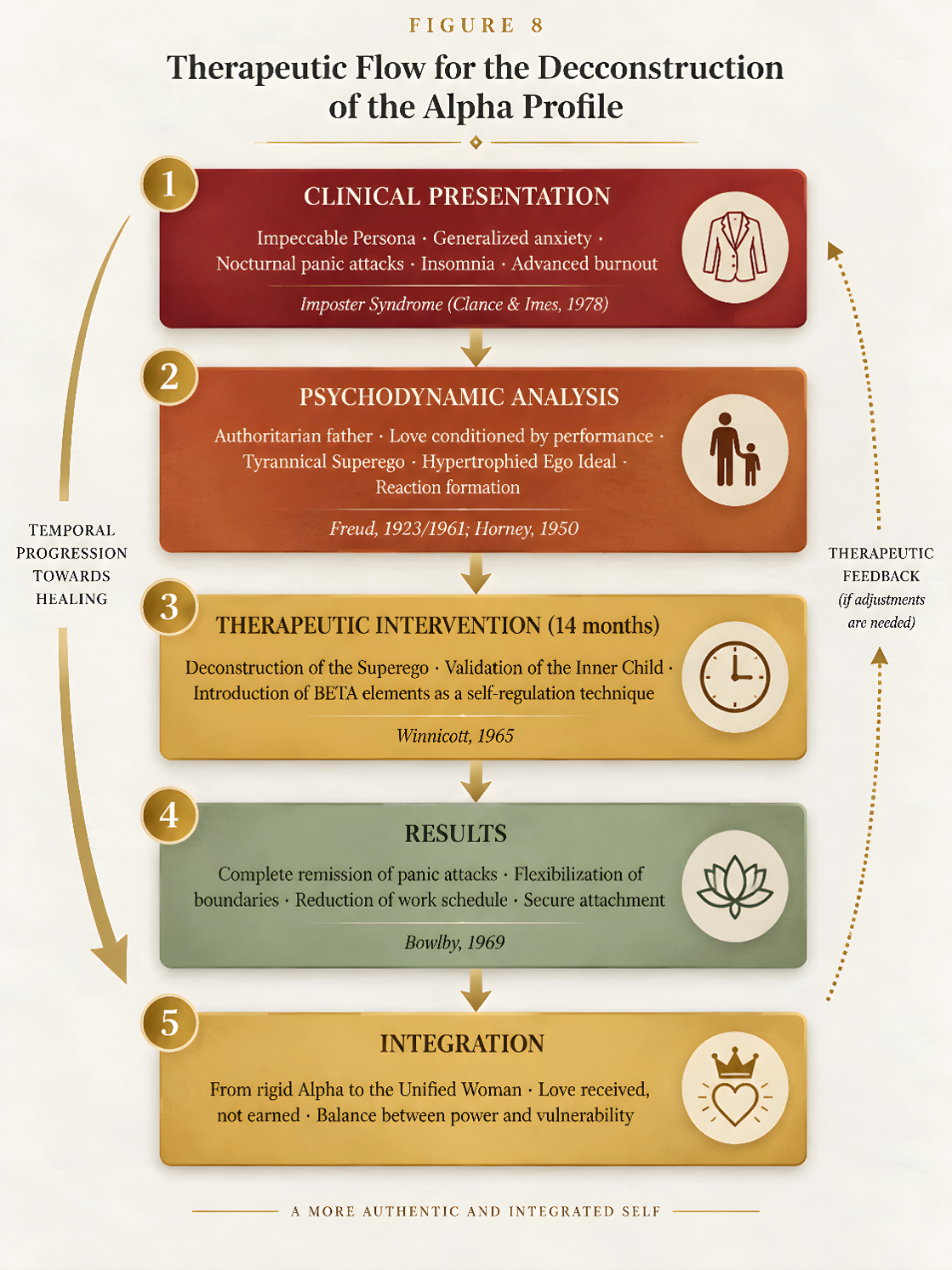
Figure 8. Therapeutic flow for the deconstruction of the Alpha profile and Imposter Syndrome. The diagram synthesizes the five stages of the integrative psychoanalytic intervention applied to The composite patient — referred to here as ‘M.’ — is a 39-year-old woman: (1) clinical presentation — impeccable Persona, generalized anxiety, nocturnal panic attacks, advanced burnout; (2) psychodynamic analysis — authoritarian father, love conditioned by performance, tyrannical Superego, reaction formation; (3) therapeutic intervention (14 months) — deconstruction of the Superego, validation of the Inner Child, introduction of BETA elements as a self-regulation technique; (4) results — complete remission of panic attacks, flexibilization of boundaries, secure attachment; (5) integration — from rigid Alpha to the Unified Woman. (Conceptual design: Tihan E.J., 2026)
As observed in Figure 8, the therapeutic flow follows a clear trajectory: from the identification of the rigid Persona and the traumatic family dynamic, through the deconstruction of the tyrannical Superego and the validation of the Inner Child, toward measurable clinical results — remission of panic attacks and the capacity to receive love without earning it through performance.
5.2. Vignette 2: Deconstruction of the BETA Profile and the Savior Complex
Anamnesis and Clinical Picture
The second composite vignette illustrates a different clinical pattern, centered on the dynamics of the savior complex and codependency. As with the previous vignette, it does not represent a real patient, but synthesizes recurring dynamics observed in psychotherapeutic practice.
Her clinical discourse was centered exclusively on the former partner (an individual with active addictions and a history of infidelity): “I don’t understand where I went wrong. I offered him everything. I paid his debts, I cared for him when he was sick, I endured his insults. I believed that if I offered him enough love and stability, he would change. Last week he packed his bags and told me: ‘You are too good for me, you suffocate me.'” This case illustrates the classic manifestation of the Savior Complex and codependency (Norwood, 1985).
Psychodynamic Analysis
In analyzing the developmental history, a childhood marked by an unstable family environment was highlighted. The patient’s mother suffered from a chronic invalidating illness, and the father was emotionally absent. V. underwent a process of premature parentification: from a tender age, she had to care for her mother and younger siblings, learning to read the micro-expressions and needs of adults to maintain a climate of safety. She became the emotional radar of the house, forgetting to listen to her own signal (Winnicott, 1965).
Psychodynamically, V. structured a dependent Ego, whose value existed only through the prism of its usefulness to others. Her principal defense mechanism was projection and projective identification: she projected her own vulnerability and need to be saved onto dysfunctional partners, transforming herself into their compulsive savior. She confused attachment with total sacrifice. The partner’s words acted as an invalidation of her entire defensive system, leaving the Ego completely uncovered in the face of abandonment anxiety (Klein, 1946/1975).
Therapeutic Intervention and Results
The therapeutic process lasted 11 months and focused on the reconstruction of the Ego’s boundaries.
- Sanctioning of Relational Boundaries (Sacred Limits): Intensive work was done on introducing the therapeutic exercise extracted from the text: the utterance of “small but firm noes” in everyday relationships, without experiencing guilt.
- Deconstruction of the Myth of Pure Reflection: V. was helped to understand that she is not merely a body that reflects the light of others, but possesses her own light, independent of her social utility. Work was done on identifying her own desires and bodily limits (Rogers, 1961).
- Integration of the Autonomous Pole (Sigma/Alpha): The patient was guided to internalize characteristics of autonomy specific to sovereign archetypes — to learn to inhabit her own body as a home, not as a currency of exchange for affection.
Results: At the conclusion of treatment, V. manifested a profound restructuring of her relational dynamic. She refused to become involved again in compulsive savior relationships. She reported a significant increase in autogenous self-esteem and reoriented professionally toward mentoring projects where the offering of help is structured institutionally, not personal-compulsively (Rogers, 1961).
6. DISCUSSIONS
The extended analysis of the feminine archetypes (Alpha, Beta, Gamma, Sigma, Omega) proposed in the present research demonstrates the heuristic value of fluid-dynamic models in the face of rigid psychometric taxonomies. In an era in which personality is often reduced to mathematical scores, the qualitative and semiotic approach brings to the foreground the living subject, with its traumas, defenses, and aspirations (Hillman, 1975).
The central stake of the model resides in the dissolution of intra-gender conflict fueled by social structures. As the text affirms with acuity, the tense dynamic between Alpha, Beta, Gamma, and Sigma finds its resolution in the capacity of the Omega archetype to gather them together in a space of radical acceptance. From a clinical point of view, this intervention represents a model for the total containing therapeutic space, where compensatory masks can be laid down without fear of being judged (Winnicott, 1965).
The passage from the pole of rigid performance (Alpha) or self-dissolving sacrifice (Beta) toward cosmic sovereignty (Sigma) and, finally, toward ecological integration (Omega) describes a complete identity trajectory. The body ceases to be a public showcase or an instrument of production, becoming once again an altar of pure presence (Fredrickson & Roberts, 1997).
To provide a synthetic visual representation of the differences and overlaps between the five archetypal constellations, we have elaborated a radar diagram illustrating their differentiated profiles on five fundamental psychological dimensions (see Figure 9).
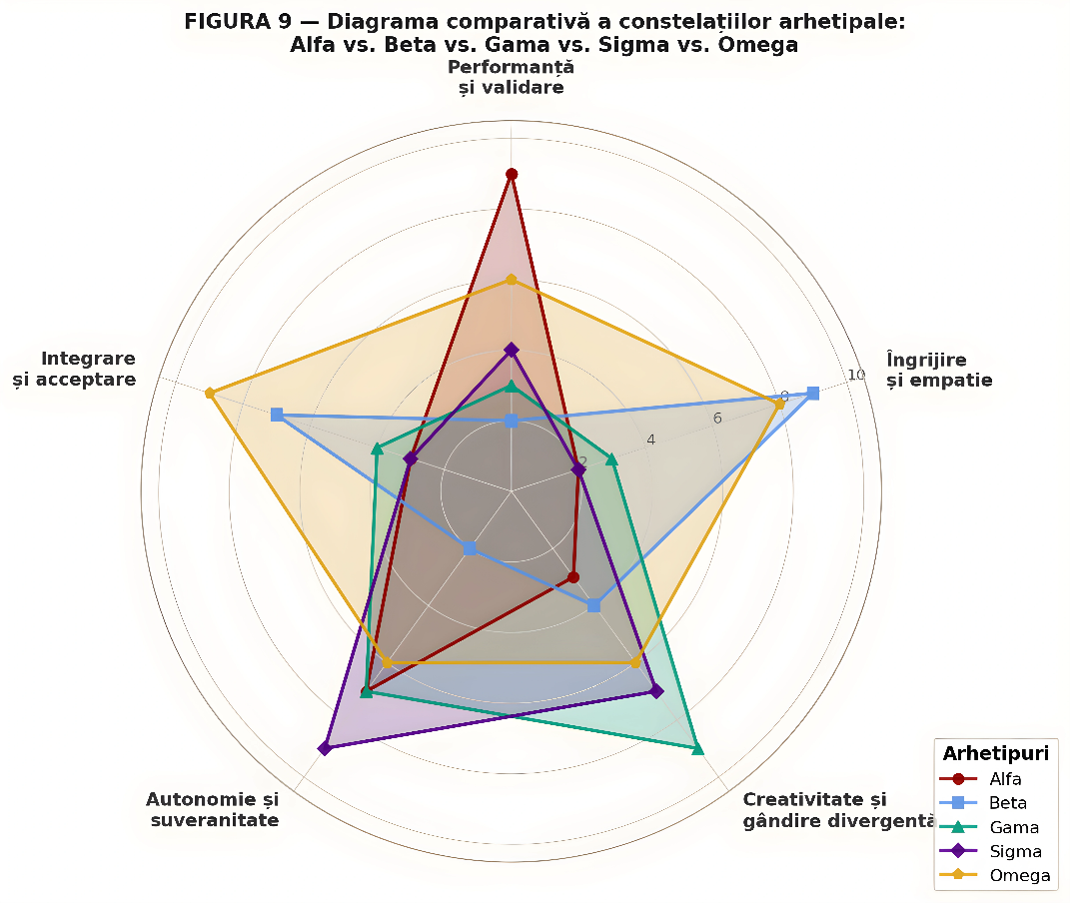
Figure 9. Comparative diagram of archetypal constellations: Alpha, Beta, Gamma, Sigma, and Omega. The radar diagram illustrates the differentiated profiles of the five archetypes on five fundamental psychological dimensions: (1) performance and validation, (2) care and empathy, (3) creativity and divergent thinking, (4) autonomy and sovereignty, (5) integration and acceptance. Each colored polygon represents the specific configuration of an archetype: Alpha dominates on the performance axis, Beta on the care axis, Gamma on the creativity axis, Sigma on the autonomy axis, and Omega presents a balanced profile, with emphasis on integration and acceptance. The overlapping of polygons suggests the permeability and coexistence of archetypes within the same Self. (Conceptual design: Tihan E.J., 2026)
As observed in Figure 9, each archetype has a distinct profile: Alpha dominates on the performance and validation axis, Beta on the care and empathy axis, Gamma on the creativity and divergent thinking axis, Sigma on the autonomy and sovereignty axis, and Omega presents a balanced profile, with emphasis on integration and acceptance. The overlapping of polygons suggests that these constellations are not mutually exclusive, but coexist and interpenetrate in the psychic economy of the feminine Self.
To provide a comparative synthesis of the five feminine archetypes, we have elaborated a table that systematizes the principal psychological, anthropological, and clinical dimensions analyzed in the article (see Table 1). The table allows the reader to rapidly identify the differences and similarities between profiles, offering at the same time a conceptual map useful for clinical practice.
TABLE 1 — Comparative Synthesis of the Five Feminine Archetypes
| Dimension | ALPHA | BETA | GAMMA | SIGMA | OMEGA |
| Anthropological archetype | Queen / Athena | Demeter / Hestia | Muse / Persephone | Artemis / She-Wolf |
Great Mother / Gaia |
| Psychic structure | Compensatory narcissism | Dependent personality | Constructive borderline porosity | Schizoid dynamic | Cohesive Self / Individuation |
| Principal defense mechanism | Reaction formation | Projection and projective identification | Intellectualization and fantasy escape | Defensive withdrawal | Radical acceptance and transcendence |
| Attachment type | Avoidant | Anxious-ambivalent | Disorganized | Avoidant-schizoid | Secure (integrated) |
| Sensuality | Conquest | Total giving | Intellectual (sapiosexual) | Sovereign | Erotic peace |
| Cosmology | Sun | Moon | Falling star | Universe | Humus |
| Pathological risk | Burnout, imposter syndrome | Codependency, reactive depression | Performance anxiety, financial instability | Defensive isolation, masked depression | Sweet melancholy, withdrawal |
| Path of healing | Deconstruction of the Superego | Tracing sacred limits | Channeling divergent thinking | Flexibilization of boundaries | Radical acceptance and presence |
Table 1. Comparative synthesis of the five feminine archetypes. The table synthesizes the principal psychological, anthropological, and clinical dimensions of the five archetypes analyzed in the article: anthropological archetype, psychic structure, principal defense mechanism, attachment type, sensuality, cosmology, pathological risk, and path of healing. The table offers a comparative perspective that allows the reader to rapidly identify the differences and similarities between profiles. (Conceptual design: Tihan E.J., 2026)
As observed in Table 1, the five archetypes differ significantly in terms of psychic structure, defense mechanisms, attachment type, sensuality, cosmology, and pathological risks. Alpha is structured around a compensatory narcissism, with a defense mechanism based on reaction formation and an avoidant attachment type; her pathological risk is burnout and imposter syndrome, and her path of healing passes through the deconstruction of the tyrannical Superego. Beta is structured around a dependent personality, with a defense mechanism based on projection and projective identification and an anxious-ambivalent attachment type; her pathological risk is codependency and reactive depression, and her path of healing passes through tracing sacred limits. Gamma is structured around a constructive borderline porosity, with a defense mechanism based on intellectualization and fantasy escape and a disorganized attachment type; her pathological risk is performance anxiety and financial instability, and her path of healing passes through channeling divergent thinking. Sigma is structured around a schizoid dynamic, with a defense mechanism based on defensive withdrawal and an avoidant-schizoid attachment type; her pathological risk is defensive isolation and masked depression, and her path of healing passes through the flexibilization of boundaries. Omega, finally, is structured around a Cohesive Self, with a defense mechanism based on radical acceptance and transcendence and a secure (integrated) attachment type; her pathological risk is sweet melancholy and withdrawal, and her path of healing passes through radical acceptance and pure presence. The table thus offers a complete comparative map, useful both for clinicians and for readers interested in archetypal dynamics.
Limits and Precautions
- Qualitative and Conceptual Nature: Although it has a solid anchoring in depth clinical casuistry, the model is an ideal-typical one. In everyday clinical reality, profiles interpenetrate; no patient can be mechanically reduced to a single typology (Maxwell, 2013).
- Risk of Re-labeling: The uncontrolled use of these terms outside the specialized clinical space can generate new forms of normative pressure or stereotyping of women (American Psychiatric Association, 2022).
- Cultural Specificity: The model focuses on the psychology of the woman exposed to modern urban pressures; its validity in traditional communities or in non-Western cultural spaces requires supplementary investigations (Markus & Kitayama, 1991).
Recommendations for Further Research
- Development of a Psychometric Instrument: The creation and statistical validation of a multifasic questionnaire based on the five profiles to measure their distribution in the general population and correlation with classical personality models (MBTI, Big Five) (Costa & McCrae, 1992).
- Longitudinal Studies on Developmental Crises: Investigation of how passage through moments of crisis (burnout, divorce, grief) acts as a catalyst for the evolutionary transition toward the Omega phase (Erikson, 1968).
- Analysis of Couple Dynamics: Study of the compatibility and specific conflicts that appear when these feminine archetypes interact with different typologies of masculine or partner attachment (Gottman & Levenson, 1992).
7. CONCLUSIONS AND CLINICAL RECOMMENDATIONS
The present study demonstrates that the Alpha, Beta, Gamma, Sigma, and Omega archetypes constitute a theoretical and clinical instrument of exceptional value for understanding the contemporary feminine psyche. They describe an evolutionary spiral in which adaptive suffering, masked by performance, sacrifice, or isolation, can be decoded, understood, and ultimately integrated (Jung, 1959/2003).
The synergy between psychology and art allows the articulation of a non-pathologizing scientific discourse. The supreme stake of feminine existence is not the attainment of a static perfection dictated by external standards, but the acquisition of the courage to navigate flexibly among all these inner states. The supreme triumph is found in the Omega archetype: the capacity to become once again the fertile “humus” of one’s own life, transforming each trauma into a stage of the return to the sovereign matrix of being (Rogers, 1961).
To synthesize the complete identity trajectory described in the article — from the rigid performance of Alpha to the ecological integration of Omega — we have elaborated a spiral diagram illustrating the five evolutionary stages (see Figure 10).
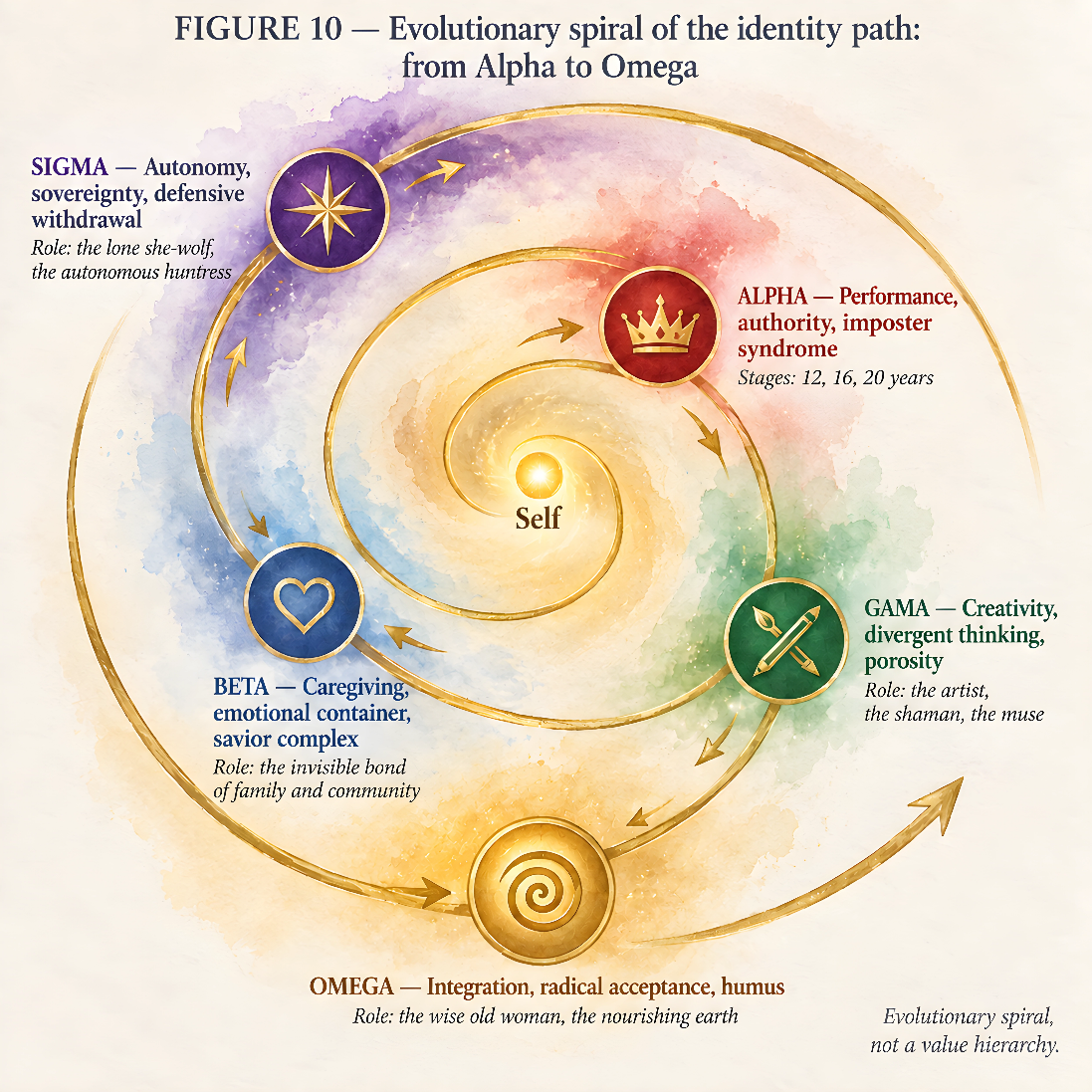
Figure 10. The evolutionary spiral of the feminine identity trajectory: from Alpha to Omega. The diagram illustrates the complete identity trajectory described in the article: from Alpha (performance, authority, imposter syndrome), through Beta (care, emotional container, savior complex), Gamma (creativity, divergent thinking, porosity), Sigma (autonomy, sovereignty, defensive withdrawal), toward Omega (integration, radical acceptance, humus). The spiral suggests evolutionary movement, not a value hierarchy; each node is connected to the others through golden arrows, indicating the permeability and coexistence of archetypes. The center of the spiral represents the Self (Jungian Self), from which the entire identity trajectory unfolds. (Conceptual design: Tihan E.J., 2026)
As observed in Figure 10, the feminine identity trajectory is not a linear path, but an evolutionary spiral, in which each stage is necessary and each is found in the next. From Alpha (performance, authority, imposter syndrome), through Beta (care, emotional container, savior complex), Gamma (creativity, divergent thinking, porosity), Sigma (autonomy, sovereignty, defensive withdrawal), toward Omega (integration, radical acceptance, humus), the woman traverses a process of psychic maturation that ultimately leads her to the authentic Self.
Exploratory Clinical Considerations:
- For Alpha Profiles: Therapists may consider guiding the patient beyond the Persona, supporting the deconstruction of the tyrannical Superego. The intervention must validate the right to rest and vulnerability without this being perceived as a failure or weakness (Clance & Imes, 1978).
- For Beta Profiles: The clinical focus must be placed on tracing “sacred limits.” The patient must be helped to differentiate her own Ego from the partner’s needs and to abandon the compulsive caregiving pattern in favor of self-love (Norwood, 1985).
- For Gamma Profiles: Structured channeling of divergent thinking into concrete creative projects is recommended, concomitantly with techniques for reducing financial and performance anxiety through anchoring in immediate reality (Kabat-Zinn, 1990).
- For Sigma Profiles: The principal therapeutic objective is the flexibilization of boundaries to prevent the transformation of independence into schizoid defensive isolation. The patient must be supported to experience intimacy under conditions of safety (Guntrip, 1969).
- For Facilitating the Omega Stage: The intervention must use techniques of radical acceptance, bodily mindfulness, and shadow integration, allowing the patient to pass from the logic of production to the logic of pure presence (Kabat-Zinn, 1990; Jung, 1959/2003).
Academic Contribution
This article brings an original contribution to the field of personality psychology and cultural psychoanalysis by bringing depth essayism to standards of academic rigor. The proposed explanatory model extends classical archetype theory and offers clinicians a fluid map, updated to current socio-economic realities, facilitating therapeutic interventions centered on integration, self-regulation, and the dissolution of identity conflicts (Hillman, 1975).
ACKNOWLEDGMENTS
The authors thank the persons and institutions that supported, as the case may be, the process of documentation, writing, and editorial preparation of the manuscript. No person who does not meet the criteria for authorship is presented as a co-author.
DECLARATIONS
Author Contributions
Tihan Mihaela Laura: Presentation of the model (Alpha, Beta, Gamma, Sigma, Omega); development of the narrative and essayistic corpus; contribution to the interpretation of archetypes from a narrative and aesthetic perspective analyzed in this article; critical review of the essayistic sections of the manuscript.Roles (CRediT): Conceptualization; Methodology (narrative); Writing – original draft (essayistic sections); Writing – review & editing (narrative sections).
Tihan Eusebiu Jean: Conceptualization of the psychological framework; development of the qualitative methodology; integration of specialized literature; formal analysis; clinical and psychoanalytic interpretation of the archetypes; construction of the composite clinical vignettes; preparation of the scientific apparatus (methodological notes, tables, diagrams); creation of the original artistic component (visual design of the archetypal portraits, Figures 1–10); primary drafting and verification of the manuscript; critical revision; final analysis; preparation of the final version.
Roles (CRediT): Conceptualization; Methodology (psychological and qualitative); Formal analysis; Investigation (literature review); Writing – original draft (psychological and methodological sections); Writing – review & editing; Visualization (artistic design, Figures 1–10, Table 1); Supervision; Project administration.
Both authors approved the final version and assume responsibility for the content.
Funding
This research received no external funding.
Conflict of Interest
The authors declare no conflict of interest.
Generative Artificial Intelligence Use Statement
Generative AI-assisted tools were used for editorial assistance in structuring, language refinement, and preparation of the manuscript from the supplied source material. The authors remain fully responsible for the originality, accuracy, integrity, citations, analysis, interpretation, and conclusions of the manuscript. Generative AI is not listed as an author or co-author.
Ethics Approval and Informed Consent
The study analyzed a supplied textual document and did not recruit human participants, collect interviews, administer psychological tests, or process clinical records. Therefore, informed consent from research participants was not applicable to the present document analysis. If future versions include identifiable human materials, appropriate ethical review and informed consent or a documented exemption must be obtained.
Data Availability
The primary qualitative corpus is the document supplied by the authors for analysis. No personal participant dataset was generated. Any future media or image corpus should be documented and archived in accordance with copyright, privacy, and ethical requirements.
All illustrations (Figures 1–10) and tables (Table 1) are original works of the authors, created especially for this article. They do not contain identifiable elements of real persons and are not reproductions of copyrighted materials.
LIST OF ILLUSTRATIONS AND TABLES
Figure 1. The spiral of the five feminine archetypes — conceptual diagram
Figure 2. The Alpha Woman — watercolor portrait
Figure 3. The Beta Woman — watercolor portrait
Figure 4. The Gamma Woman — watercolor portrait
Figure 5. The Sigma Woman — watercolor portrait
Figure 6. The Omega Woman — watercolor portrait
Figure 7. The psychological mirror — synthetic illustration
Figure 8. Therapeutic flow for the deconstruction of the Alpha profile — flow diagram
Figure 9. Comparative diagram of archetypal constellations — radar diagram
Figure 10. The evolutionary spiral of the feminine identity trajectory — spiral diagram
Table 1. Comparative synthesis of the five feminine archetypes
BIBLIOGRAPHY
- Ainsworth, M. D. S., Blehar, M. C., Waters, E., & Wall, S. (1978). Patterns of attachment: A psychological study of the strange situation. Lawrence Erlbaum. ISBN: 0898594618 / 9780898594614, https://doi.org/10.4324/9780203758045
- American Psychiatric Association. (2022). Diagnostic and statistical manual of mental disorders (5th ed., text rev.). American Psychiatric Association Publishing. ISBN: 978-0-89042-575-6 (Print); 978-0-89042-578-7 (Online), https://doi.org/10.1176/appi.books.9780890425787
- Barthes, R. (1977). Image, music, text (S. Heath, Trans.). Fontana Press. ISBN: 0006540678, ISBN: 0-00-634880-7
- Bateson, G., Jackson, D. D., Haley, J., & Weakland, J. (1956). Toward a theory of schizophrenia. Behavioral Science, 1(4), 251–264. https://doi.org/10.1002/bs.3830010402
- Bauman, Z. (2000). Liquid modernity. Polity Press. ISBN: 0-7456-2409-X , ISBN: 0745624103 / 9780745624105
- Bowlby, J. (1969). Attachment and loss: Vol. 1. Attachment. Basic Books. ISBN: 046500539X / 9780465005390, ISBN: 0701203005, ISBN: 0712674713 / 9780712674713
- Braun, V., & Clarke, V. (2006). Using thematic analysis in psychology. Qualitative Research in Psychology, 3(2), 77–101. https://doi.org/10.1191/1478088706qp063oa
- Clance, P. R., & Imes, S. A. (1978). The imposter phenomenon in high achieving women: Dynamics and therapeutic intervention. Psychotherapy: Theory, Research & Practice, 15(3), 241–247. https://doi.org/10.1037/h0086006
- Costa, P. T., Jr., & McCrae, R. R. (1992). NEO PI-R professional manual. Psychological Assessment Resources.
- Denzin, N. K. (1978). The research act: A theoretical introduction to sociological methods (2nd ed.). McGraw-Hill, ISBN: 0070163618 / 9780070163614
- Eagly, A. H., & Karau, S. J. (2002). Role congruity theory of prejudice toward female leaders. Psychological Review, 109(3), 573–598. https://doi.org/10.1037/0033-295X.109.3.573
- Eagly, A. H., & Wood, W. (1999). The origins of sex differences in human behavior: Evolved dispositions versus social roles. American Psychologist, 54(6), 408–423. https://doi.org/10.1037/0003-066X.54.6.408
- Erikson, E. H. (1968). Identity: Youth and crisis. W. W. Norton., ISBN: 0393010694/ 9780393010695, ISBN: 0393311449 / 9780393311440
- Fairbairn, W. R. D. (1952). Psychoanalytic studies of the personality. Tavistock Publications. ISBN: 0415051746 / 9780415051743, ISBN: 020312944X / 9780203129449
- Fredrickson, B. L., & Roberts, T.-A. (1997). Objectification theory: Toward understanding women’s lived experiences and mental health risks. Psychology of Women Quarterly, 21(2), 173–206. https://doi.org/10.1111/j.1471-6402.1997.tb00108.x
- Freud, S. (1961). The ego and the id (J. Riviere, Trans.). W. W. Norton. (Original work published 1923)
- Goffman, E. (1959). The presentation of self in everyday life. Doubleday.
- Gottman, J. M., & Levenson, R. W. (1992). Marital processes predictive of later dissolution: Behavior, physiology, and health. Journal of Personality and Social Psychology, 63(2), 221–233. https://doi.org/10.1037/0022-3514.63.2.221
- Guntrip, H. (1969). Schizoid phenomena, object relations and the self. International Universities Press.
- Herman, J. L. (1992). Trauma and recovery: The aftermath of violence. Basic Books.
- Hillman, J. (1975). Re-visioning psychology. Harper & Row.
- Hochschild, A. R. (1983). The managed heart: Commercialization of human feeling. University of California Press.
- Horney, K. (1950). Neurosis and human growth: The struggle toward self-realization. W. W. Norton.
- Horowitz, M. J. (2004). Stress response syndromes (4th ed.). Jason Aronson.
- Jung, C. G. (2003). Opere complete (Vol. 9/1). Editura Trei. (Original work published 1959)
- Kabat-Zinn, J. (1990). Full catastrophe living: Using the wisdom of your body and mind to face stress, pain, and illness. Delacorte Press.
- Kernberg, O. F. (1975). Borderline conditions and pathological narcissism. Jason Aronson.
- Klein, M. (1975). Notes on some schizoid mechanisms. In Envy and gratitude and other works 1946–1963 (pp. 1–24). Hogarth Press. (Original work published 1946)
- Kohut, H. (1971). The analysis of the self. International Universities Press.
- Kress, G., & van Leeuwen, T. (2006). Reading images: The grammar of visual design (2nd ed.). Routledge.
- Markus, H. R., & Kitayama, S. (1991). Culture and the self: Implications for cognition, emotion, and motivation. Psychological Review, 98(2), 224–253. https://doi.org/10.1037/0033-295X.98.2.224
- Maxwell, J. A. (2013). Qualitative research design: An interactive approach (3rd ed.). SAGE Publications.
- Moscovici, S. (2000). Social representations: Explorations in social psychology. Polity Press. (Original work published 1961)
- Norwood, R. (1985). Women who love too much. Pocket Books.
- Pincus, A. L., & Lukowitsky, M. R. (2010). Pathological narcissism and narcissistic personality disorder. Annual Review of Clinical Psychology, 6, 421–446. https://doi.org/10.1146/annurev.clinpsy.121208.131215
- Rogers, C. R. (1961). On becoming a person: A therapist’s view of psychotherapy. Houghton Mifflin.
- Winnicott, D. W. (1965). The maturational processes and the facilitating environment. Hogarth Press.
Nota
[3] A major theoretical direction in contemporary sociology, the theory of liquid modernity proposes replacing the metaphor of solid structure with that of fluid to describe the post-institutional human condition. It is inscribed in the line of poststructuralist thought and the critique of postmodernity, having affinities with Ulrich Beck’s work on the “risk society” and Gilles Deleuze’s on “control societies.”
Tihan, Laura Mihaela; Tihan, Eusebiu Jean (2026) Feminine Archetypes in Contemporary Psychology: A Psychoanalytic and Qualitative Analysis of Personality, Sensuality, and Identity Dynamics, Cunoașterea Științifică, 5:4, DOI: 10.58679/CS17191, https://www.cunoasterea.ro/en/feminine-archetypes-in-contemporary-psychology/




Leave a Reply